There is nothing more dangerous in enterprise SaaS than a green dashboard that is lying to you. Your E2E tests are passing. But your system might still fail in production.
Because what you’re validating are flows not how the system behaves when everything interacts under real conditions.
And that gap is where most failures hide. That’s how most end-to-end testing still works.
We check the parts. We check the flows. We even check the integrations. But we rarely ask:
If this one thing fails, what else goes down with it?
E2E testing was supposed to be the safety net. The final gate before production. The thing that catches what unit and integration tests miss. And to be fair, most teams rely on it that way. According to the World Quality Report, over 60% of organizations use automated regression and E2E testing as their primary release gate.
But here’s what doesn’t get talked about enough:
- Your E2E suite validates flows. Not systems.
- A passing test says nothing about dependency risk or blast radius.
- Flaky tests aren’t just annoying — they’re eroding your release confidence daily.
In this guide, we’ll break down why E2E testing is insufficient without Enterprise Validation and why more teams are starting to rethink how they decide what’s safe to ship.
What Is Enterprise Validation? (And How Is It Different from E2E Testing?)
Most teams already understand E2E testing. You simulate real user journeys — login, search, checkout and check if those flows complete without breaking.
That’s useful. But it doesn’t really answer the question you care about right before a release.
Is this actually safe to ship? Because passing flows don’t always mean a stable system.
Enterprise Validation goes beyond what traditional testing can actually prove. Instead of validating workflows in isolation, it steps back and asks how the entire system behaves when something changes.
Individually, everything might still “work.” But the system as a whole? That’s where things get unpredictable.
That risk was always there. Enterprise Validation tries to make that visible — showing where it concentrates, how far a change can ripple, and which parts of the system have been unstable before..
| Dimension | E2E Testing | Enterprise Validation |
| Focus | Individual user workflows | Overall release readiness |
| Core question | Does this flow work? | Is this safe to ship? |
| Risk model | Pass/fail per test | Risk spread across system |
| Scope | Functional correctness | Business impact + system risk |
| Ownership | QA / testers | Engineering leadership + QA |
| Output | Test results | Ship or hold decision |
Related Reading: End to End Testing: Everything You Need to Know in 2026
Why E2E Testing Is Insufficient Without Enterprise Validation
E2E testing gives you confidence. But in complex systems, it’s often the misleading kind.
It validates what you planned to test, not what actually happens when everything starts interacting.
And that’s where unknowns start to surface usually when it’s already too late.
Because once your system behaves like a real system — distributed, unpredictable, slightly messy- that false confidence starts to crack.
Here’s where E2E starts to fall short:
- E2E tests validate paths, not risk: A green run tells you checkout works. It doesn’t tell you a small auth change just expanded risk across multiple workflows.
- Coverage ≠ confidence: 90%+ coverage, and production still breaks. Because coverage shows what was tested, not what should’ve been based on change impact or past failures.
- E2E tests don’t model dependencies: They validate flows that touch a service. They don’t show how a change ripples across the system. That’s where things quietly fail.
- They slow down releases instead of guiding them: Large E2E suites take hours. Teams either skip them or wait and still don’t know if it’s safe to ship. Pass/fail isn’t a decision.
- No business context: All flows are treated equally. But a login failure and a payment failure don’t carry the same risk. Your testing shouldn’t treat them the same either.
What Does Enterprise Validation Actually Look Like?
Once you move past test execution, Enterprise Validation starts to look less like more testing and more like a system for making release decisions.
At its core, it’s built on three layers:
Understanding the system → Measuring risk → Deciding what to ship.
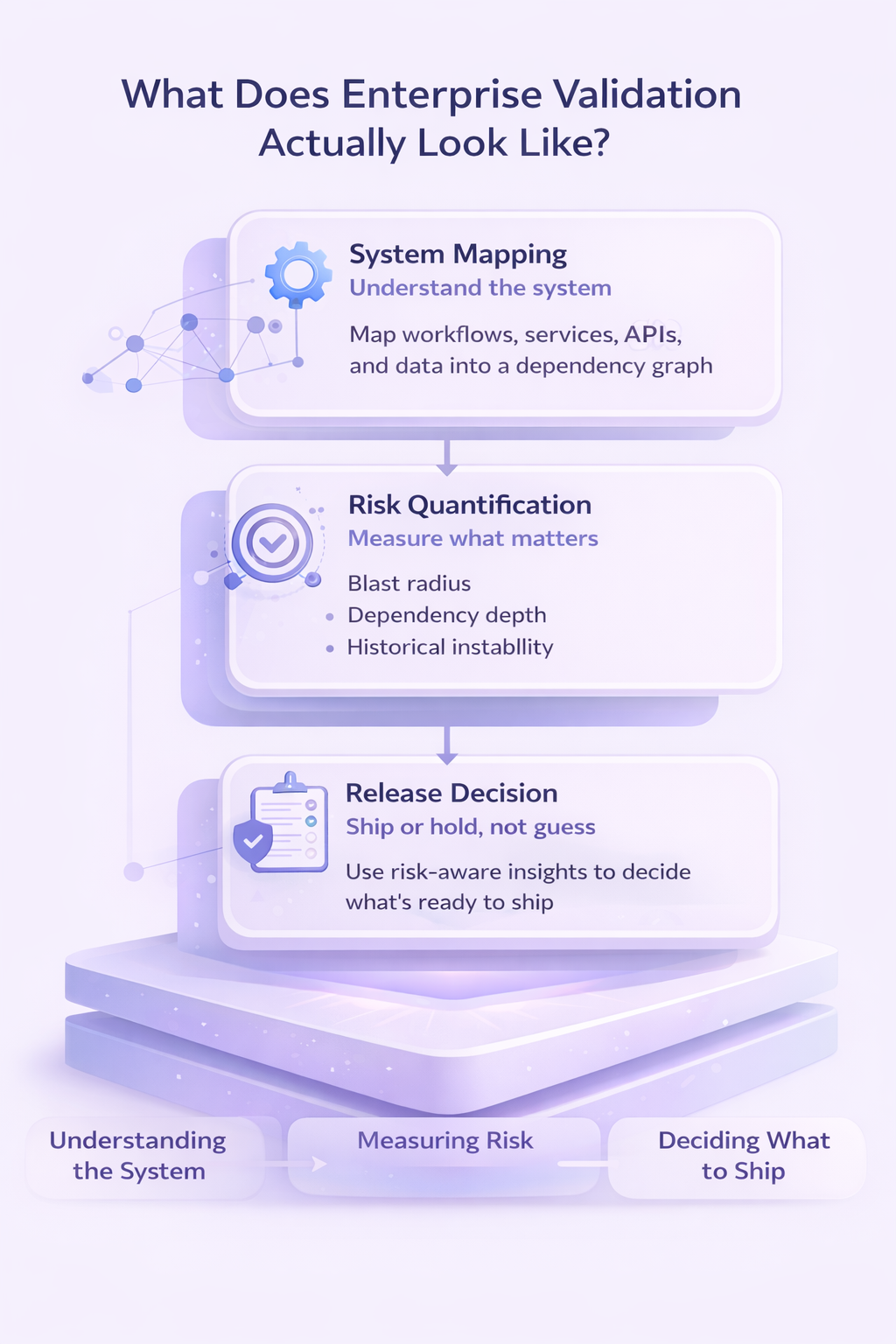
1. System Mapping (Understand the system)
Before you validate anything, you need to see it clearly. Enterprise Validation maps how workflows, services, APIs, and data layers connect not as isolated tests, but as a living dependency graph.
2. Risk Quantification (Measure what matters)
Not every change carries the same weight. Enterprise Validation breaks risk down into a few core parameters:
- Blast radius — how far a change can impact the system
- Dependency depth — how many services and workflows are connected to it
- Historical instability — where failures have already shown up before
Under the hood, this is powered by workflow topology modeling, change impact analysis, and deterministic validation but what teams see is a clear picture of where risk is actually building.
3. Release Decision (Ship or hold, not guess)
This is where it all comes together. Instead of relying on green dashboards or gut feel, teams get a clearer, explainable view of release risk. Not just test results but context.
Enterprise Validation doesn’t replace E2E testing. It sits above it. It takes the test results you already have and turns them into something far more useful: a risk-aware, system-level view of release readiness.
The Real Cost of Releasing Without Enterprise Validation
Relying on E2E testing alone doesn’t just create blind spots. It shows up where it hurts the most in the business.
- Revenue loss from system-level failures: Things don’t break inside flows, they break between systems, where money is actually made.
- Brand damage: A single production issue can quietly erode customer trust faster than you can fix it.
- Eroded team trust: Flaky tests and surprise failures push teams toward gut-feel releases instead of real confidence.
- Compliance and audit exposure: “Tests passed” isn’t proof — regulated environments need traceable validation of critical workflows.
- Systemic instability: Without visibility into risk, small changes keep triggering unpredictable, cascading failures.
Learn More: If your tests are passing but production still breaks, the issue runs deeper. Read Why Traditional Software Quality Strategies Fail in Enterprises to see what’s really holding systems back.
How Enterprise Validation Complements Your Existing E2E Strategy
Transitioning toward Enterprise Validation is about upgrading your “mental model” of what a successful release looks like. If you have an E2E suite, you have a foundation, now you need the intelligence to make it matter.
Here’s how to move from test execution to real release confidence:
- Prioritize Revenue, Not Coverage: Don’t try to automate everything. Start with your 10–15 most critical workflows — billing, payments, and core user actions. That’s where failures actually hurt the business.
- Map Dependencies, Not Just Flows: Your E2E tests follow a path. Your system doesn’t. A single service change can ripple across multiple systems, so your validation needs to capture that full impact.
- Use Risk-Based Release Decisions: Move beyond pass/fail. Not all changes carry the same risk. Focus deeper validation where the potential impact is higher.
- Make Validation Traceable: Don’t rely on assumptions or tribal knowledge. Every release should clearly show what was validated and what risks were accepted.
- Make Quality a Leadership Concern: This isn’t just QA’s responsibility. Engineering leaders need real confidence before shipping. Validation should guide decisions, not just report results.
How Aquila Enables Enterprise Validation
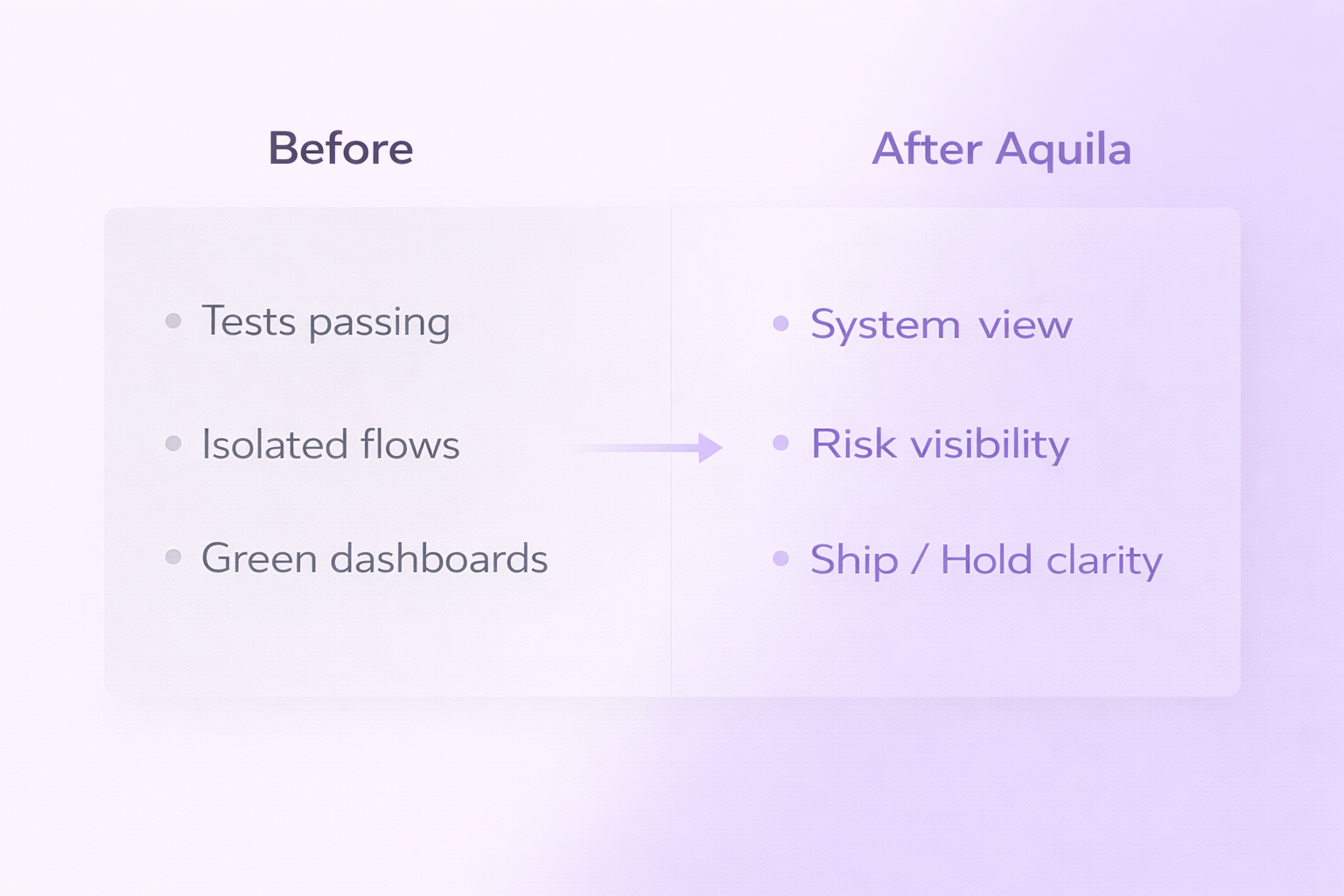
Most teams already have automation. What they’re missing is a way to turn test execution into release decisions. That’s the shift Aquila is built around.
From execution → validation → governance
Automation executes tests. Aquila is a living map of your enterprise ecosystem—illuminating how changes in one service impact the data integrity of your entire workflow.
And finally, it governs the release. Not just signals… but a clear view of readiness.
From workflows to system understanding: Enterprise systems aren’t collections of tests. They’re connected workflows where dependencies intersect. Aquila maps this as a validation graph showing how critical workflows operate and where failures are likely to cluster.
From results to risk concentration: A pass/fail result doesn’t tell you much. Aquila identifies risk concentration where changes, dependencies, and past instability overlap.
From test output to release intelligence: Aquila combines workflow topology, change impact, and historical signals into a single layer of release intelligence. The outcome isn’t a report. It’s a Release Readiness Index — a clear, explainable signal of whether you should ship or hold.
Beyond Test Execution — Toward Enterprise Validation
Nobody is saying throw out your E2E tests. They catch real bugs. They validate real workflows. They belong in every serious QA strategy.
But if your release decision comes down to “all tests passed, so we ship” — that’s not confidence. That’s a habit.
Enterprise environments don’t fail because teams skip testing. They fail because the testing they do was never designed to account for how systems actually break through dependency chains, structural risk, and change impact that no individual test case can see.
Enterprise validation closes that gap. The teams releasing with confidence in 2026 aren’t running more tests than everyone else. They just know what their tests actually mean for the business.
Ready to move from test results to release confidence?
Frequently Asked Questions (FAQ)
1. Why is E2E testing not enough for modern applications?
E2E testing validates predefined user flows, but modern systems fail in unpredictable ways across services, dependencies, and data layers. It misses system-level risks that don’t show up in scripted paths.
2. What is Enterprise Validation in software testing?
Enterprise Validation is a system-level approach that evaluates how your entire application behaves under real-world conditions. It focuses on risk, dependencies, and release readiness, not just test outcomes.
3. How is Enterprise Validation different from traditional testing?
Traditional testing checks if individual components or flows work. Enterprise Validation looks at how everything works together especially under change, stress, and real-world complexity.
4. Can Enterprise Validation replace E2E testing?
No. Enterprise Validation builds on top of E2E testing. E2E ensures flows work, while Enterprise Validation ensures the system is safe to release.
References
- World Quality Report: Annual report on software quality trends, test automation adoption, and QA maturity across enterprises.
https://www.capgemini.com/insights/research-library/world-quality-report-2024-25