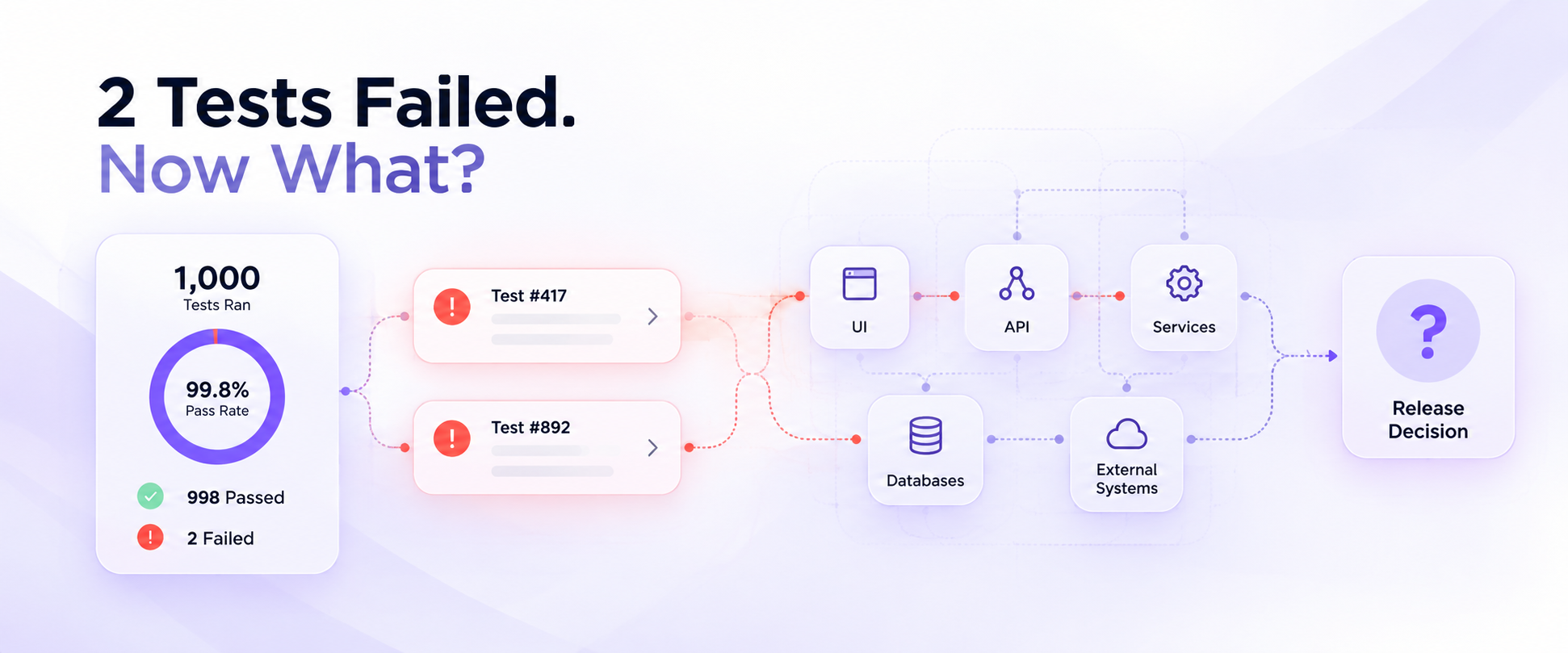
1,000 tests ran overnight. 998 passed. Two failed.
The release is scheduled for 10 a.m. The team is already on the call, staring at the dashboard. One failure looks harmless. The other sits somewhere in a critical workflow.
So, do they ship?
They have the logs, the screenshots and the stack traces. They know exactly which test failed. But knowing what failed doesn’t necessarily tell them why it failed, what else it touches, or whether it puts the release at risk.
And that is the uncomfortable part. Modern test infrastructure can give teams more visibility than ever, yet a release decision can still come down to, “We think we’re okay.”
Because a failure is an observation. Understanding what it means for the system is something else entirely.
A failure is only the beginning.
What is Test Observability?
Test observability is the practice of collecting and connecting data from test execution to understand what happens when a test runs, passes, or fails.
It goes beyond a simple pass/fail result. A test observability setup can bring together:
- Test results and execution history
- Logs and error messages
- Screenshots and traces
- Environment and infrastructure data
- Failure patterns and flaky tests
- Test duration and performance trends
Together, this gives QA and engineering teams a clearer picture of where and how tests fail.
But seeing a failure is only the starting point. Test observability can show that a payment test failed and surface the error behind it. The harder question is what that failure means for the release.
Related Reading: Why traditional software quality strategies fail in modern enterprise systems
Why “What Failed” Isn’t Enough
Knowing that a test failed is useful. But it’s only the starting point.
Imagine a payment workflow fails overnight. The dashboard shows the failed test and the error behind it. But what caused it? An API change? A database issue? A third-party service? Or just a flaky test?
In an enterprise environment, that workflow might cross the UI, APIs, services, databases, and external systems.
So the real questions are:
- Why did it fail?
- What changed?
- What else could be affected?
- How much risk does it create?
- Can we still release safely?
Because knowing what failed isn’t the same as knowing what it means.
Related Reading: Beyond Test Automation: What Modern Software Quality Needs
Why It Matters
When teams can see failures but can’t understand their impact, release decisions get harder than they need to be.
- More test data ≠ more confidence.
- Not every failure carries the same risk.
- Critical problems can hide between interconnected systems and create a much larger blast radius.
- A passing test doesn’t always mean a healthy workflow.
- Without context, release decisions become guesswork.
The goal isn’t to find more failures. It’s to understand which ones matter for the release.
The real question is where that failure sits in the dependency network—and how much risk is concentrated around it.
Related Reading: Risk-Based Testing: Why Some Workflows Matter More Than Others
How Enterprise Validation Solves This
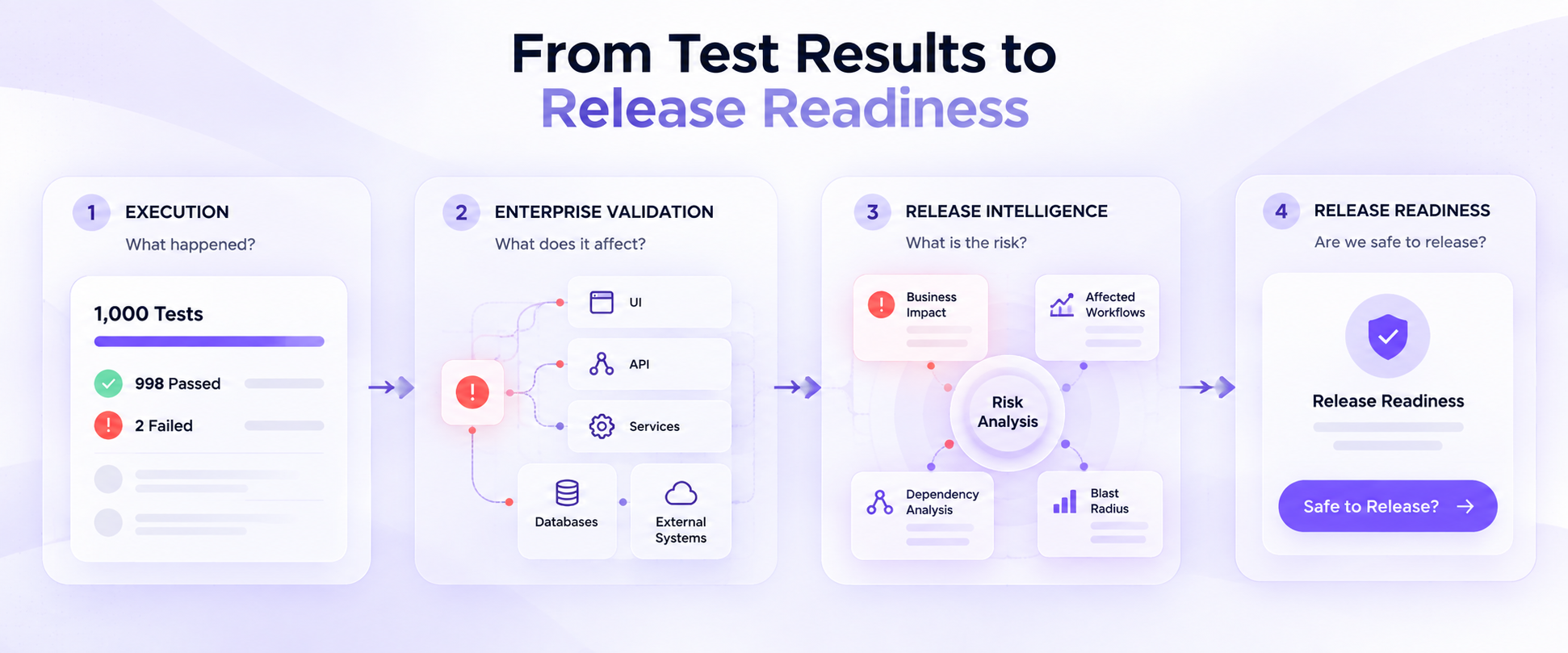
From failures to release confidence.
The answer isn’t necessarily more tests. It’s more context around the tests you already have.
Enterprise Validation connects test results to critical workflows across UI, APIs, databases, and dependent systems. It helps teams understand whether a failure is isolated or part of a larger problem.
Aquila brings these connections together through Enterprise Validation, while Release Intelligence turns validation findings into a clearer understanding of risk.
The result? Teams can move beyond individual test failures and make informed Release Readiness decisions.
Because knowing what failed is useful. Knowing whether it’s safe to ship is what really matters.
Related Reading: Enterprise Validation vs. Test Automation: What’s the Difference?
How to Build a Test Observability Practice
Test observability becomes valuable when it helps teams answer a bigger question: What does this test result tell us about the health and risk of the release?
Start with a few fundamentals:
- Track the context. Capture logs, environment details, and execution history alongside failures.
- Look for patterns. Don’t treat every failure as an isolated event.
- Prioritize critical workflows. Give more attention to failures that affect important business journeys.
- Connect the dots. Understand how tests relate to the systems and dependencies they exercise.
- Add risk to the picture. Ask what each failure means for the release, not just whether the test passed or failed.
That’s when test observability starts supporting something bigger than debugging: a clearer understanding of release risk.
Related Reading: Why Enterprises Need Release Confidence, Not Just More Automation
From Test Results to Release Confidence
Two failed tests shouldn’t leave a team staring at a dashboard wondering whether to ship.
They should have enough context to understand what happened, what those failures affect, and whether critical workflows are at risk.
Because the question at the end of a test run isn’t “How many tests failed?”
It’s “Are we actually safe to release?”
That’s where test observability needs to go further. Observability explains the failure. Enterprise Validation connects it to critical workflows and dependencies. Release Intelligence shows what that means for release risk.
Ready to move beyond test results? Schedule a demo with Aquila.
Frequently Asked Questions (FAQs)
1. What is test observability?
Test observability is the practice of collecting and connecting data from test execution to understand what happens when a test runs, passes, or fails. It can bring together test results, logs, screenshots, traces, environment data, and failure patterns.
2. Why isn’t knowing what failed enough?
Knowing which test failed is only the starting point. Teams also need to understand why it failed, what changed, which workflows or systems could be affected, and what the failure means for the release.
3. How does Enterprise Validation improve test observability?
Enterprise Validation connects test results to critical workflows and the systems behind them, including UI, APIs, databases, and dependencies. This helps teams understand whether a failure is isolated or part of a larger release risk.
4. Can test observability help teams make better release decisions?
Yes. Test observability provides the execution data and context teams need to understand failures. When that information is connected to workflows and release risk, teams can make more informed Release Readiness decisions instead of relying on test results alone.