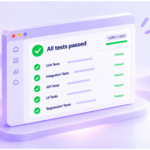
Your release process can be mature, your pipelines automated, and your quality gates green. Yet none of that guarantees your next release won’t disrupt a critical business operation.
The problem? Engineering maturity and release confidence aren’t the same thing. A change can pass every check and still trigger failures across interconnected systems, where the impact extends far beyond the code that changed.
DORA’s 2024 research found that more than half of the teams studied showed differences between software delivery throughput and stability. Shipping changes efficiently and delivering them reliably are two distinct challenges.
For CTOs, the question isn’t just how quickly teams can ship. It’s whether they have enough visibility into what a release could break before it reaches production.
What is Release intelligence
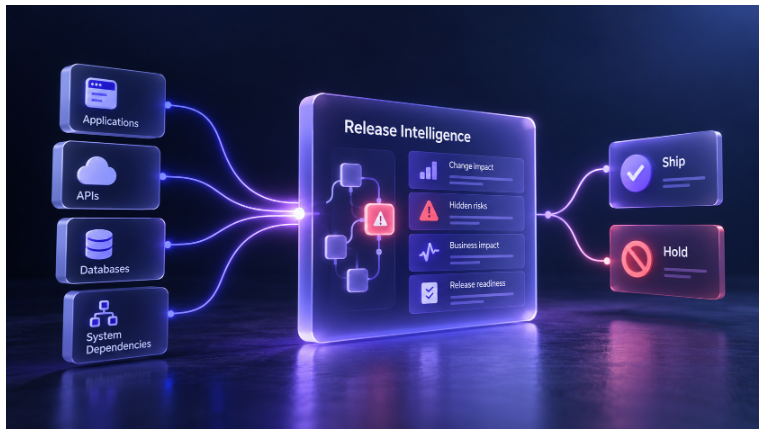
Release Intelligence turns enterprise validation evidence into an understanding of release risk, business impact, and unresolved gaps across critical workflows and their dependencies.
Rather than relying solely on test results or deployment status, it connects the dots across applications, APIs, databases, and system dependencies to build a clearer picture of release risk.
In practice, this means looking beyond whether individual tests passed and asking what those results tell you about the wider enterprise system. Release Intelligence helps teams:
- Assess change impact across connected systems and workflows.
- Identify hidden risks that isolated tests may miss.
- Prioritize issues based on potential business impact.
- Evaluate release readiness using evidence, not just test pass rates.
Related Reading: Release Readiness: The New KPI for Modern Engineering Teams
Why Traditional Release Risk Assessment Fails Enterprise Teams
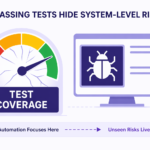
Most release risk assessments rely on test pass rates, coverage metrics, and pipeline statuses. These signals show how individual checks perform, but they tell you nothing about how a change impacts interconnected enterprise systems.
Imagine explaining to your CFO why invoices stopped going out after a release that passed every quality gate. The ERP is healthy, the CRM is online, and your APIs return 200 OKs. Yet a subtle field change silently severed the handoff between order processing and billing.
From a component-level, everything looks fine. From a business perspective, revenue operations are at risk.
Traditional approaches often miss these risks because of:
- Siloed testing: Components pass; cross-system workflows fail.
- Fragmented signals: Test reports don’t reveal the full picture.
- Hidden dependencies: Small changes trigger unexpected downstream failures.
The root issue isn’t a lack of test automation—it’s the complete lack of visibility into cross-system business risk.
Related Reading: Why traditional software quality strategies fail in modern enterprises
How Can You Assess Release Risk? A Practical Framework
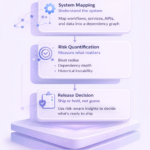
Before a release goes live, ask three questions: What changed? What could it break? Is it safe to ship? A practical framework helps teams answer with evidence, not assumptions.
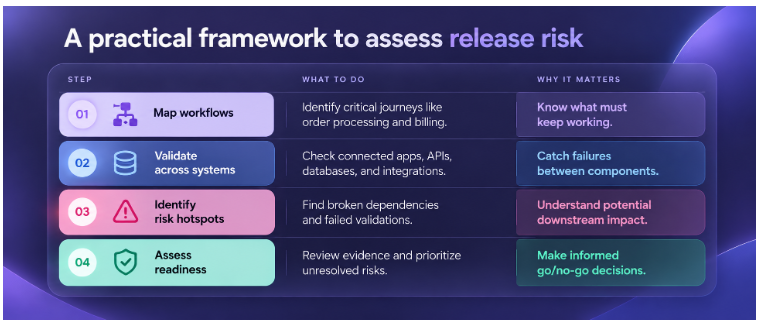
The goal isn’t to eliminate every risk. It’s to understand what could break, what it could affect, and whether you’re ready to release.
Related Reading: Risk-Based Testing: Why Some Workflows Matter More Than Others
How Does Enterprise Validation Enable Release Intelligence?
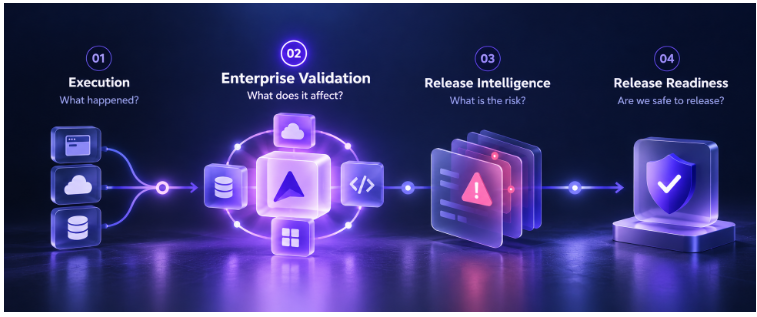
Test results tell you what happened. But understanding what a change affects, where risk lies, and whether a release is safe requires a bigger picture.
Aquila connects the four stages, from Execution to Release Readiness. Its codeless Enterprise Validation platform validates critical workflows across UI, APIs, and databases, helping teams uncover risks across interconnected systems and make better-informed release decisions.
Conclusion: Release Confidence Requires More Than Passing Tests
Production shouldn’t be where you discover what your tests missed.
Release Intelligence starts with understanding how changes affect the wider enterprise, not just whether individual checks pass. Aquila’s Enterprise Validation platform helps teams validate critical workflows across UI, APIs, and databases before release.
Ready to see what your release process might be missing? Schedule a demo with Aquila.
Frequently Asked Questions (FAQs)
What is Release Intelligence in software development?
Release Intelligence uses evidence from enterprise validation to help teams understand release risk, identify gaps, and assess whether critical workflows are ready for a software release.
How do you assess software release risk?
Assess software release risk by mapping critical workflows, validating interactions across connected systems, identifying unresolved gaps and dependencies, and evaluating the evidence before approving a release.
What is the difference between test automation and Enterprise Validation?
Test automation executes predefined checks. Enterprise Validation assesses whether critical workflows continue to function across connected applications, APIs, databases, and integrations.
How does Release Intelligence improve release readiness?
Release Intelligence helps teams interpret validation evidence, understand potential business impact, prioritize unresolved issues, and make more informed release decisions.