Drop a pebble into a still pond and watch what happens. One tiny splash, and rings of water spread outward in every direction.
Nobody threw a boulder. It was just a pebble. But the ripple didn’t know the difference.
Enterprise software behaves much the same way.
According to Gartner, more than 50% of outages impacting mission-critical services are caused by change, configuration, release integration, and hand-off issues rather than infrastructure failures or hardware problems.
Modern outages are rarely infrastructure failures anymore. They’re propagation failures.
A harmless configuration change quietly breaks onboarding workflows. A dependency update stalls billing. A third-party API outage spreads through systems that were never expected to be affected.
That’s blast radius at work — and understanding it is often the difference between a minor issue and a major release incident.
What Is Blast Radius in Enterprise Software Systems?
Blast radius is the scope of impact a failure, deployment change, or system issue can have across connected services, workflows, and business operations.
In simpler terms, it answers one question:
If this breaks, what else breaks with it?
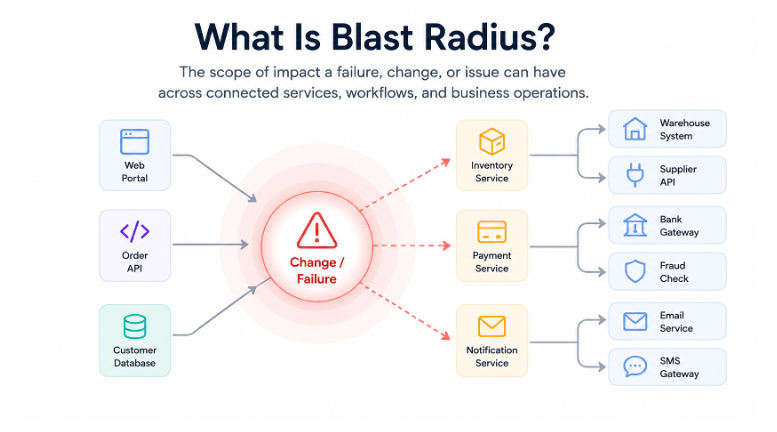
The original issue may live in one component but the consequences rarely do.
That’s because modern applications aren’t isolated systems anymore. They’re networks of APIs, databases, third-party services, event streams, and AI models all depending on one another to keep business moving.
The more critical workflows and downstream systems depend on a component, the larger the potential blast radius.
Related Reading: Risk-Based Testing: Why Some Workflows Matter More Than Others
Blast Radius vs Root Cause: What’s the Difference?
| Concept | Meaning |
| Root cause | The original issue that triggered the incident |
| Blast radius | Everything affected after the issue occurred |
Teams often spend enormous effort finding the root cause of an incident. That’s important.
But understanding the blast radius is what determines the business impact.
A failed authentication service might be the root cause. Blocked customer onboarding, failed payments, and overwhelmed support teams are the blast radius.
How Does Blast Radius Spread Across Enterprise Systems?
The Four Common Propagation Paths
- Service Dependencies: One upstream service failure quickly cascades into downstream workflows.
- Shared Databases: A schema change or delayed data update can impact multiple systems simultaneously.
- Third-Party Integrations: External APIs and vendors can introduce failures your team doesn’t own but still has to absorb.
- Environment Drift: The code passes in staging. Production behaves differently.
These dependency chains are exactly why traditional end-to-end testing often struggles to capture real release risk. A workflow may pass from start to finish while hidden dependencies and failure paths remain completely invisible until production traffic exposes them.
How Do Teams Measure Blast Radius Before Production?
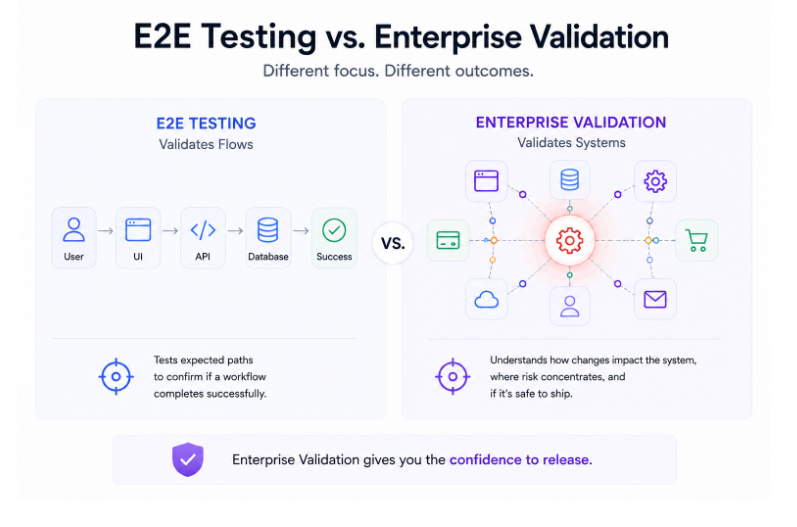
Most teams rely on testing as their primary release signal. The challenge is that traditional testing validates expected behavior, not failure propagation.
Blast radius isn’t measured by the number of tests around a component. It’s measured by how many critical workflows and downstream systems depend on it.
A passing workflow doesn’t reveal how many other workflows depend on it.
A green dashboard doesn’t tell you which service has become a single point of failure.
To measure blast radius, teams need visibility into dependencies, critical workflows, and change impact long before production traffic finds the problem for them.
| Traditional Testing | Enterprise Validation |
| Asks: Did this test pass? | Asks: Is this system safe to ship? |
| Validates individual components and workflows | Validates critical workflows across the system |
| Focuses on functional correctness | Focuses on risk propagation and business impact |
| Detects defects after they appear | Identifies risk concentration before release |
| Produces test results | Produces release intelligence |
Enterprise Validation provides that system-level view by mapping dependencies across UI, API, and data layers and revealing where failures are most likely to spread.
History has shown how expensive invisible blast radius can become. The Knight Capital trading glitch started with what appeared to be a localized deployment issue and escalated into a $440 million loss in just 45 minutes.
Why Enterprise Validation Is the Solution to Blast Radius
Mapping and simulating are only useful if something acts on them. This is where Enterprise Validation starts to move from concept to capability.
Aquila was built for exactly this challenge. Rather than testing components in isolation, Aquila helps teams:
- Map dependencies across services and workflows.
- Understand how failures propagate across UI, API, and data layers.
- Identify high-risk changes before deployment.
- Improve release confidence through system-level validation.
The result: fewer surprises, better release decisions, and a deployment process that catches cascading risk before your customers do.
Conclusion
In enterprise systems, failures rarely stay where they start.
A small change in one service can ripple through APIs, databases, third-party integrations, and business-critical workflows long before anyone realizes the impact. The challenge isn’t simply finding bugs anymore. It’s understanding how far those bugs can travel.
That’s why blast radius is no longer just an engineering concern. It’s a release governance problem.
Testing tells you whether something works. Enterprise Validation helps teams understand what happens when it doesn’t — before production finds out first.
Want to understand your system’s blast radius before production does? Schedule a demo with Aquila.