“Testing can show the presence of bugs, but not their absence.” — Edsger W. Dijkstra
Dijkstra’s warning is even more relevant in the era of microservices. In distributed systems, code isn’t the only variable. Interactions between services determine how the system behaves in production.
You can validate individual components perfectly and still face catastrophic failures when those components interact in a live environment.
This creates a gap between functional correctness and operational safety.
To ship safely, teams need more than test results. They need visibility into system behavior, dependencies, and release risk.
That is the foundation of Enterprise Validation — the model that generates Release Intelligence and enables true Release Readiness.
What is Enterprise Validation?
Modern engineering teams are moving toward Enterprise Validation, a system-aware approach to understanding how changes affect the entire software ecosystem.
Instead of relying on isolated test results, Enterprise Validation analyzes how services, APIs, and workflows interact across the system.
It works through three core outcomes:
The Model: Enterprise Validation: Maps how critical workflows and system dependencies interact across UI, API, and data layers ensuring changes don’t break the business.
The Insight: Release Intelligence: Turns system signals into actionable insights, revealing where risk is concentrated and how changes propagate across dependencies.
The Decision: Release Readiness: Generates a measurable signal—the Release Readiness Index that informs every go/no-go decision.
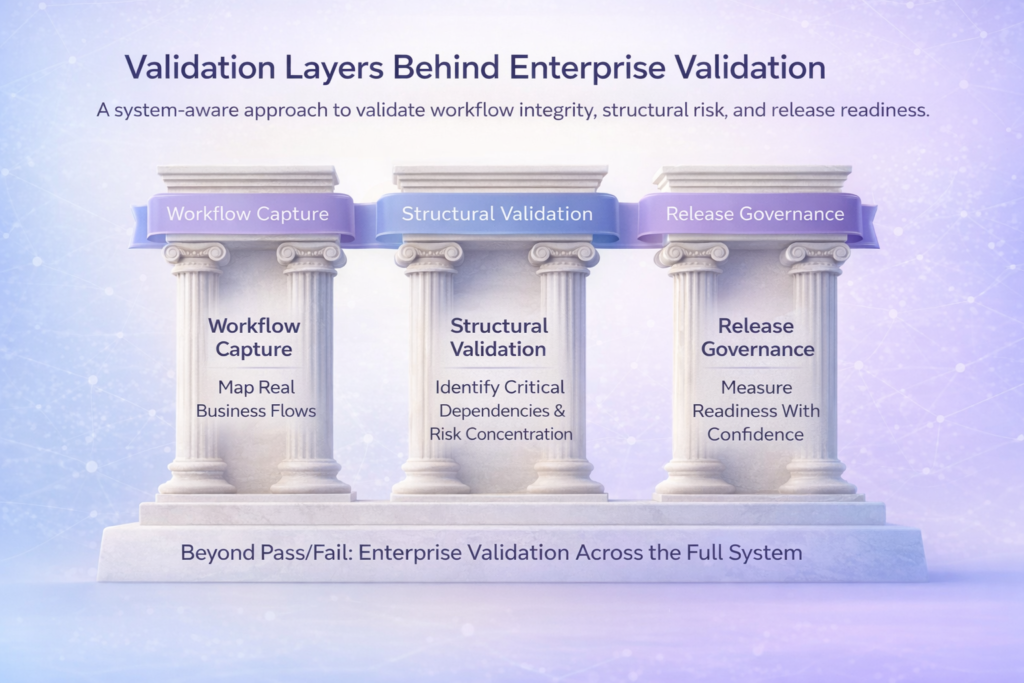
System-aware view of validation layers enabling release readiness
Why Release Decisions Are So Difficult Today
If release readiness is the goal, why is it so hard to achieve?
When releases fail, the cause is rarely a coding error. More often, the problem lies in system interactions.
- Environmental Drift: Staging may resemble production, but small configuration differences can cause unexpected behavior once the release goes live.
- Hidden Dependencies: An upstream API changes its response format or behavior, and downstream services react in ways tests didn’t anticipate.
- Unknown blast radius: A small change in one part of the system affects workflows or services that initially appear unrelated.
Teams often have plenty of test results. The real challenge is that those signals do not reveal how the entire system will behave in production.
This is exactly where Enterprise Validation becomes critical.
Related Reading: Why traditional software quality strategies fail
What Does Release Readiness Actually Mean?
In an enterprise environment, release readiness is a verified state of alignment between your code, infrastructure, and your business requirements. It’s the point where the “residual risk” of a deployment is lower than the value the release provides.
True release readiness is powered by Release Intelligence — a system-level understanding of how code, infrastructure, and dependencies interact.
The Engine of Readiness: The Release Readiness Index
To move beyond binary pass/fail signals, Aquila generates a Release Readiness Index based on three critical dimensions:
- Structural Integrity: Ensures changes do not break critical system dependencies or workflows.
- Risk Concentration: Identifies where instability is most likely to affect business operations.
- Automated Governance: Confirms every release meets defined architectural, security, and compliance standards.
Modern engineering is shifting from simply running tests to making governed release decisions.
Release readiness means having the intelligence to say: “This deployment is safe to ship because Enterprise Validation shows no risk across critical system dependencies.”
The Business Impact of Governed Release Decisions
Release decisions directly influence system stability, delivery velocity, and customer trust.
When teams rely on Enterprise Validation to generate release intelligence, the benefits extend beyond testing:
- Faster, Predictable Releases: Visibility into system dependencies allows teams to ship changes frequently without introducing instability.
- Reduced Production Incidents: By identifying structural risk before deployment, teams prevent failures that would otherwise surface in production.
- Stronger Customer Trust: Stable releases protect service reliability and ensure enterprise customers can depend on the platform.
How Aquila Powers Enterprise Validation
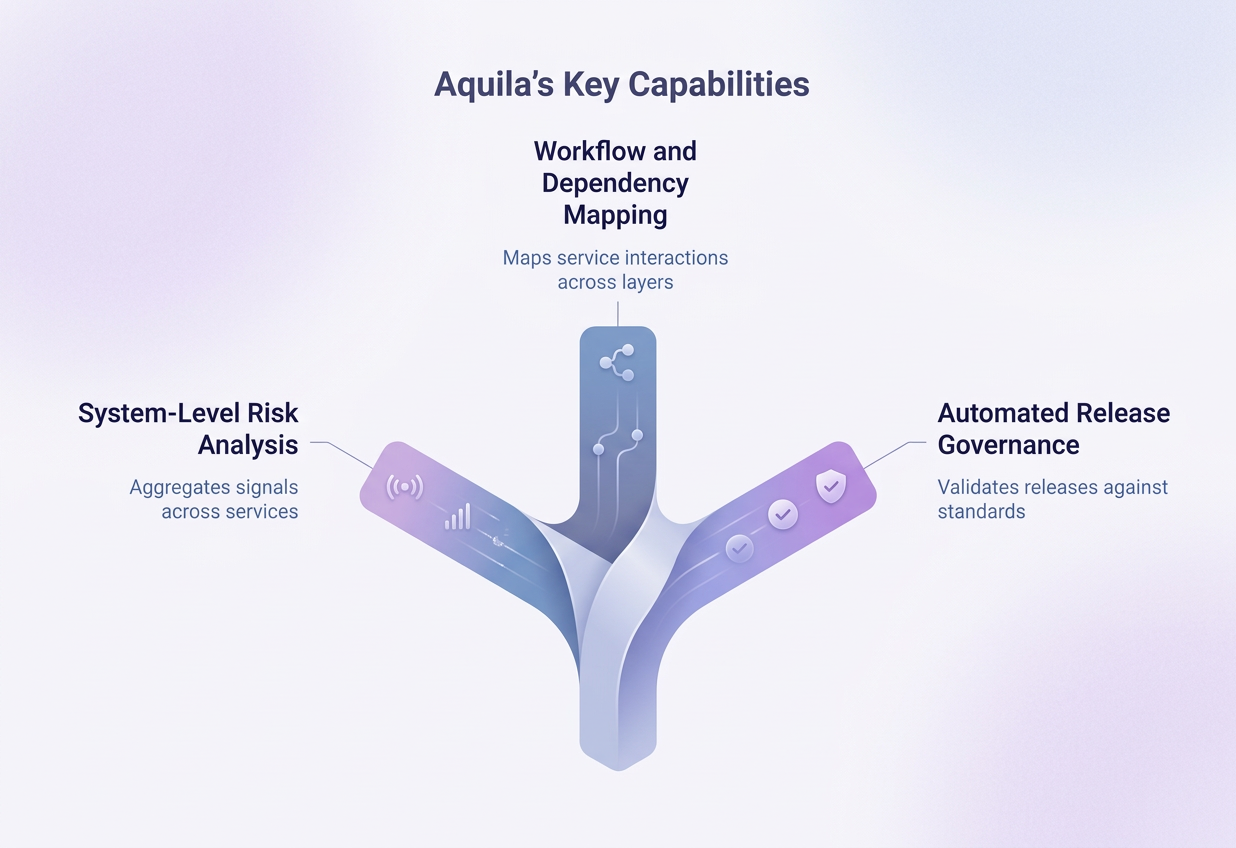
Core capabilities: workflow mapping, risk analysis, and release governance
Aquila enables Enterprise Validation by analyzing how changes move through complex software systems.
Rather than focusing on test volume, Aquila evaluates system dependencies, workflows, and risk concentration to generate the release intelligence required for governed release decisions.
Key capabilities include:
System-Level Risk Analysis: Aggregates signals across services and workflows to reveal where failures are clustering.
Workflow and Dependency Mapping: Maps how services interact across APIs, UI, and data layers to reveal how changes propagate through the system.
Automated Release Governance: Continuously validates releases against defined architectural, security, and compliance standards.
Together, these capabilities allow teams to move beyond isolated testing and make informed release decisions based on true system readiness.
Moving Toward Enterprise Validation
Modern software delivery cannot rely on pass/fail signals alone. As systems grow more complex, engineering teams need visibility into how changes behave across the entire ecosystem.
Enterprise Validation provides that visibility by generating Release Intelligence and enabling true Release Readiness.
Curious how Aquila enables Enterprise Validation? Schedule a demo to see how Aquila helps engineering teams make informed release decisions.
Frequently Asked Questions (FAQ)
What is the difference between Enterprise Validation and traditional test automation?
Traditional test automation focuses on executing test cases and reporting pass or fail results.
Enterprise Validation goes further by analyzing how services, workflows, and dependencies interact across the system. By evaluating these relationships, it generates release intelligence that helps teams understand the real impact of a change before deployment.
Why is Enterprise Validation important in microservices architectures?
Microservices environments introduce complex service dependencies that traditional testing cannot fully capture.
Enterprise Validation maps these dependencies and analyzes how a change in one service may affect other services, APIs, or workflows. This system-level visibility helps teams identify risk earlier and avoid unexpected failures after release.
What does Release Readiness mean in an enterprise environment?
Release Readiness means a deployment has been evaluated across the system and its residual risk is clearly understood.
Instead of relying only on test results, teams use release intelligence to assess how code, infrastructure, and dependencies interact. This allows engineering leaders to make informed go/no-go decisions before deployment.
How does Enterprise Validation reduce production incidents?
Enterprise Validation identifies structural risk and dependency impact earlier in the release cycle.
By analyzing critical workflows and system dependencies before deployment, teams can detect issues that traditional testing may miss. This reduces production incidents, rollbacks, and emergency fixes.