The riskiest failures aren’t the ones that crash your system. They’re the ones that let it keep running.
Wrong outputs. Broken workflows. Silent inconsistencies.
We all know how that played out for Knight Capital trading glitch. At 9:30 AM, everything looked normal. By 10:15, the firm had lost $440 million.
There was no dramatic outage. Just a deployment doing the wrong thing at scale.
That’s what makes these failures dangerous. The system doesn’t stop. It drifts.
And that’s exactly where most teams assume their Enterprise Validation checklist has them covered.
We like to think we’ve evolved since then. But systems didn’t get safer. They got more distributed, more interdependent, harder to predict and the risk didn’t disappear. It moved.
Why Testing Isn’t Enough Anymore
This is where most teams get caught. Tests are green, pipelines pass, staging looks stable. So you ship.
Then something feels off. Maybe a workflow slows down, outputs don’t align, maybe nothing crashes, but the system behaves differently.
Because testing validated your code but it didn’t validate how your system behaves under real conditions.
In modern SaaS, a release can pass every test and still fail in production due to:
- Misaligned configs
- Subtle data issues
- Dependency mismatches
That’s the gap. And it’s exactly where validation becomes critical. This is where Enterprise Validation comes in — not just to test components, but to reveal how the system behaves as a whole.
The checklist below is a practical way to reduce what we call Enterprise Dark Matter.
Related Reading: Why traditional software quality strategies fail in modern enterprise systems
The “No-Panic” Enterprise Validation Checklist
Before you hit deploy, this is the layer most teams skip:
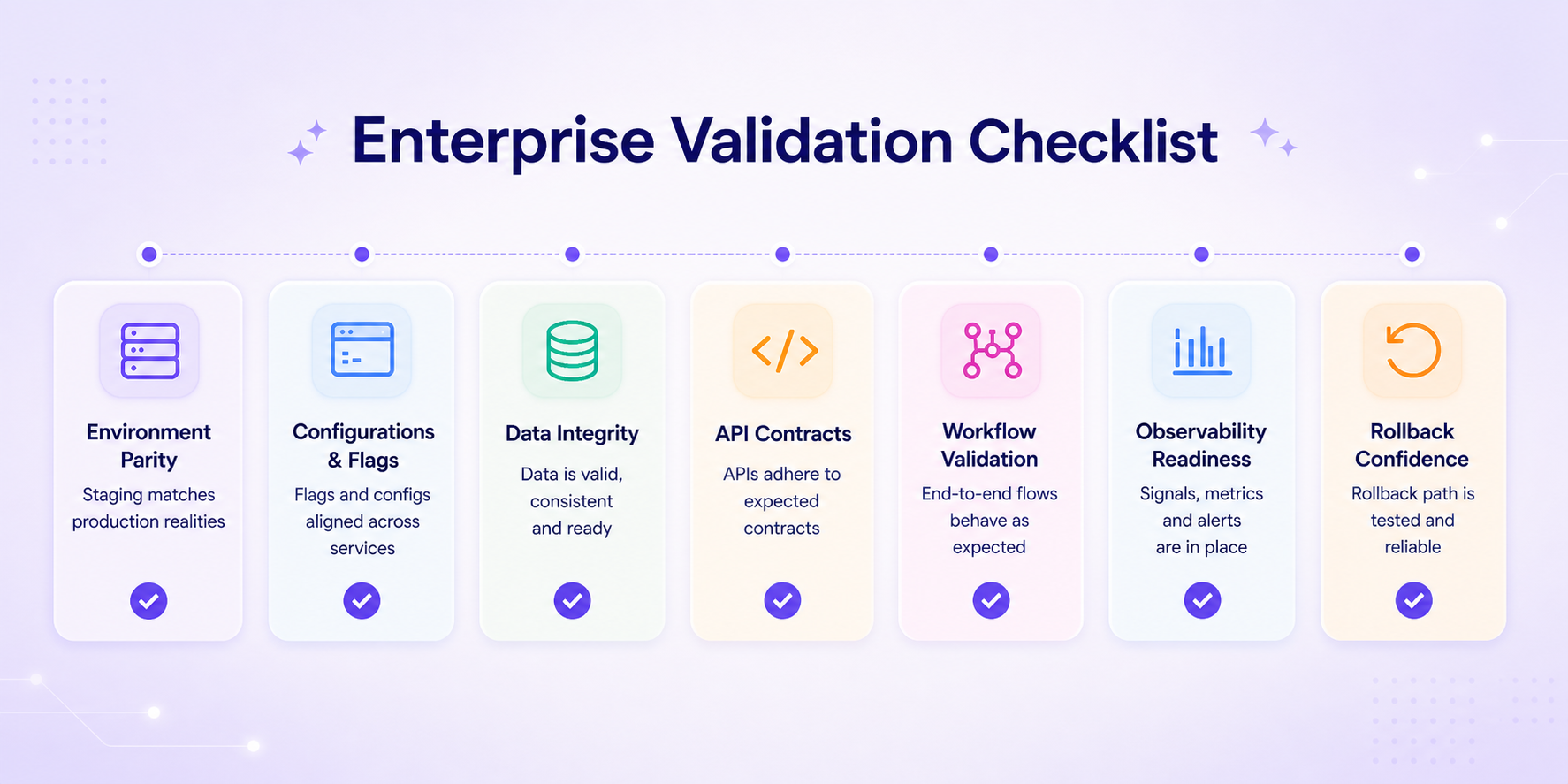
Key checks to validate system behavior before release
- Environment Parity: “Almost the same” isn’t enough. If staging doesn’t reflect production realities, your validation is incomplete.
- Feature Flags & Configurations: Flags rarely fail loudly. Misaligned configs across services create subtle, system-wide inconsistencies.
- Data Integrity Checks: Code might be stable. Data rarely is. Edge cases and unexpected formats spread issues faster than logic errors.
- API Contract Validation: APIs don’t always break. They drift. Small changes can quietly ripple across dependent services.
- Cross-System Workflow Validation: Most failures don’t live inside a service. They emerge when systems interact under real user flows.
- Observability Readiness: It’s not just about alerts. You need visibility into unusual patterns before they escalate.
- Rollback Confidence: Rollback isn’t a backup plan unless it’s tested. Otherwise, it’s just optimism under pressure.
Where Teams Usually Go Wrong
It’s rarely about lack of effort. Most teams have solid test coverage and well-structured pipelines. Releases feel controlled. But production tells a different story.
The blind spot is simple: Teams validate components, not system behavior.
Failures don’t come from isolated bugs. They emerge from interactions between services, data, and real-world usage patterns.
At Aquila, this shows up often. Strong testing maturity, but limited visibility into how systems behave once everything is live.
The Part No One Sees
Call it Enterprise Dark Matter. Risk that doesn’t show up in tests because it exists in interactions.
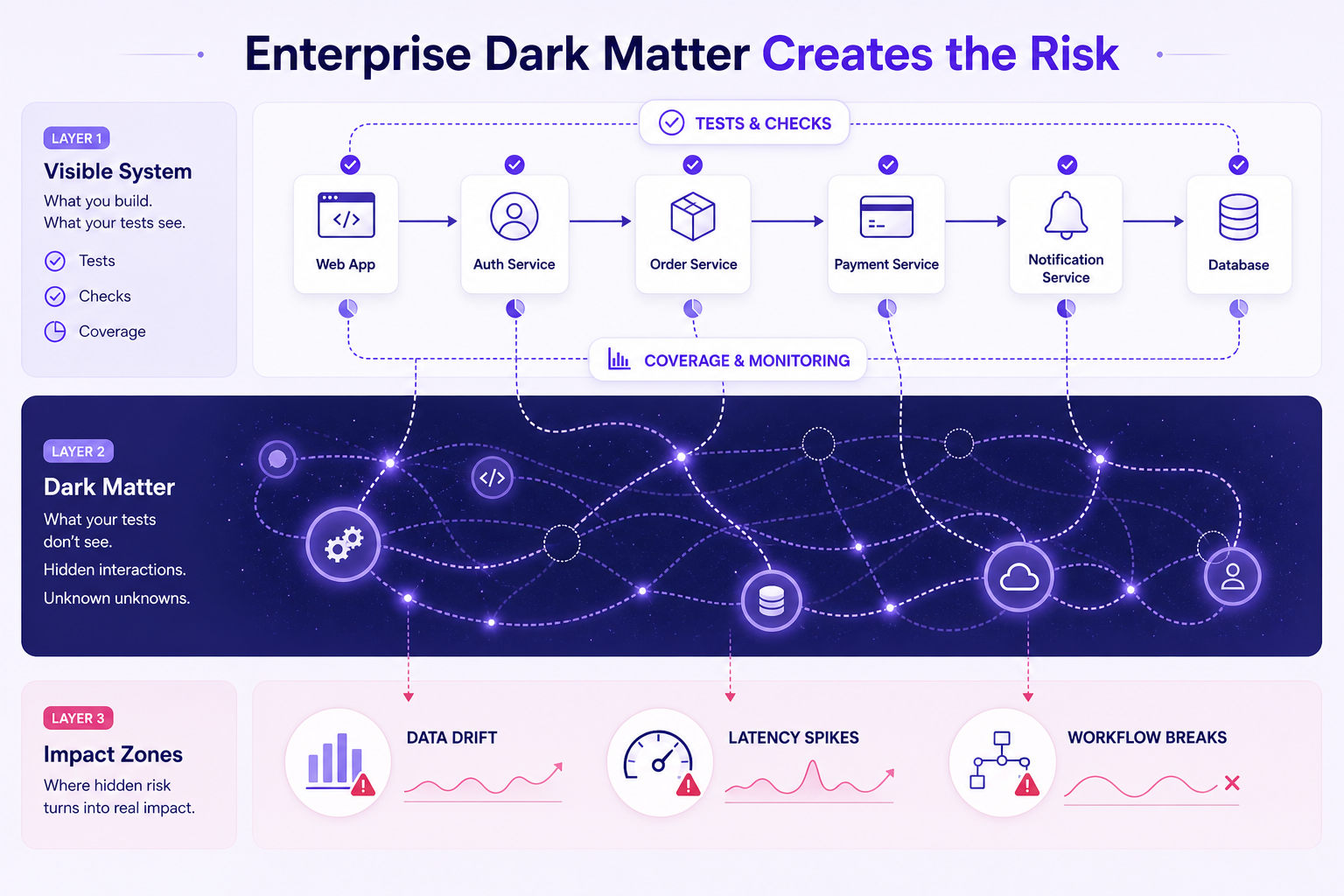
Hidden interactions create real system risk
Every release introduces new states no single test suite can fully model. That’s where uncertainty creeps in.
Validation brings that hidden layer into view. Release intelligence tells you how much it matters.
So the real question becomes: How much of your system are you actually validating—and how much are you assuming will work?
Related Reading: Why E2E testing is insufficient without Enterprise Validation
Final thought
The Knight Capital incident wasn’t just a bad deployment. It was a visibility problem.
A dormant function reactivated. Systems behaved unexpectedly. And the team had no way to see it unfolding in real time.
That edge still exists today. Green tests. Clean pipelines. Confident releases. But a checklist alone doesn’t adapt. Your system does.
Testing tells you what should work. Validation shows you what actually happens when conditions shift.
That’s the gap Aquila is built to close.
With continuous, runtime validation, Aquila helps teams see how systems behave in the wild, not just how they’re expected to behave in controlled environments.
Because real confidence doesn’t come from passing tests. It comes from knowing your system can handle what you didn’t anticipate.
👉 Stop guessing, because real confidence doesn’t come from passing tests. It comes from knowing how your system behaves when it matters. Start knowing with Aquila. Schedule a demo with our team to know more.
Frequently Asked Questions (FAQ)
What is an enterprise validation checklist?
A structured approach to ensuring systems behave correctly across environments, workflows, and dependencies before release.
Why is validation critical in CI/CD?
Because faster releases increase the chance of unnoticed issues. Validation ensures reliability keeps up with speed.
How is validation different from testing?
Testing checks individual components. Validation ensures the entire system works correctly in real-world scenarios.