Every engineering team has a version of this story. The build looked clean. Tests passed and the pipeline was green. Within an hour after deployment, a business-critical workflow broke in production. Not because a function failed. Because the system failed.
It is a more common problem than most teams admit. Research from Gartner indicates that 80% of unplanned outages are caused by change, configuration, and integration issues, not infrastructure failure or unpredictable edge cases.
That is the blind spot. And while End to End testing is designed to catch these issues by validating the full journey—UI, APIs, services, and data layers, it often falls short as systems grow more complex.
This guide breaks down how End to End testing works in modern CI/CD, where it starts to break down, and how teams can move toward more reliable system-level validation.
What Is End to End Testing?
End-to-end testing validates how an application behaves as a complete system.
Instead of testing individual functions or components, it follows real user journeys across the entire stack—UI, APIs, backend services, databases, and external integrations to ensure everything works together as expected.
Take a simple login flow. On the surface, each part might work perfectly:
- The email validation passes
- The UI responds correctly
- The database verifies the credentials
But if the session fails to initialize or the redirect breaks, the user is still blocked. That’s the layer end-to-end testing is designed to cover, not isolated functionality. But how the system behaves as a whole when real workflows are executed.
Quick Comparison
| Testing Type | What It Validate | Speed | When It Runs |
| Unit Testing | Individual functions or methods | Fast | During development |
| Integration Testing | Interactions between components | Moderate | After unit tests |
| End to End Testing | Complete user workflows across the full stack | Slower | Pre-release / in CI/CD |
End-to-end testing sits closest to real user behavior, but also comes with the highest complexity.
Why Do Teams Rely on End-to-End Testing?
Most production issues don’t come from one broken function. They show up when everything is supposed to work together but doesn’t. Individually, things pass but as a flow, they fall apart. That’s exactly the layer end to end testing covers. In practice, that translates to:
That’s the layer end-to-end testing is designed to cover. In practice, this is why teams place significant trust in E2E testing:
- Confidence before release: Validating critical workflows upfront reduces uncertainty during deployment.
- Catching integration gaps early: Issues across services, APIs, and data layers often only surface when tested as a complete flow.
- Closer to real user behavior: E2E tests follow the same paths users take, making them more representative than isolated tests.
- Reduced production surprises: Testing full workflows helps uncover issues that unit or integration tests may miss.
- Support for faster releases: When key flows are validated, teams can ship with fewer last-minute checks.
For many teams, this becomes the primary signal of release readiness. But as systems grow more complex, some failures still slip through not within the flow itself, but in the dependencies around it or how failures propagate across workflows.
That’s where the blind spots begin.
👉Related Reading: Learn why traditional software quality strategies fail in modern enterprise systems and how that gap shows up in production and business metrics.
How Does End to End Testing Work? (Step-by-Step)
In most setups, end-to-end testing follows a predictable pattern. The goal is to validate how real workflows behave across the system, not just individual components.
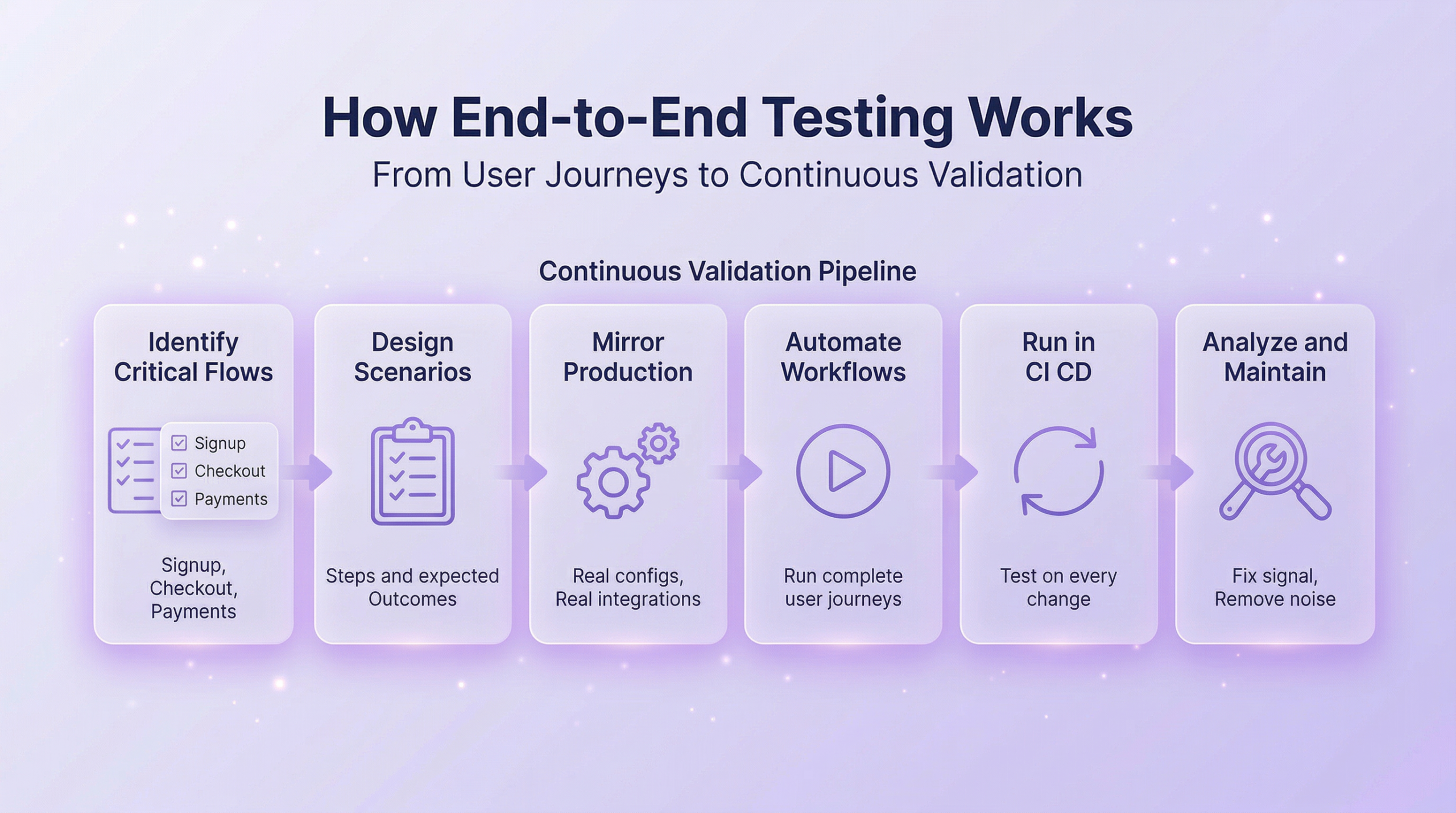
From user journeys to continuous validation in CI/CD
- Identify critical user journeys: Teams focus on workflows tied to core functionality, such as onboarding, payments, or account actions, where failures directly impact users or business outcomes.
- Design validation scenarios: Each journey is broken into steps, with clear expectations of what success looks like across the flow.
- Set up production-like environments: These workflows are executed in environments that closely resemble production, including configurations, integrations, and data behavior.
- Automate the test flows: These journeys should run continuously within your pipeline, validating real workflows as a system rather than isolated steps, an approach reflected in Aquila.
- Integrate into CI/CD: E2E validation is triggered alongside changes, ensuring workflows are checked as the system evolves.
- Analyze, fix, maintain: Not every failure indicates a real issue. Teams continuously refine flows to keep validations meaningful as systems change.
This model works well for validating defined workflows. But it still operates within the boundaries of those workflows. It doesn’t account for how failures propagate across dependencies, or how risk builds outside individual test paths.
These are the blind spots traditional end-to-end testing doesn’t capture.
Benefits & Challenges: The Realistic View
If E2E testing were easy, every team would have full coverage and zero production issues. Most teams don’t struggle because they don’t care. They struggle because maintaining E2E at scale is hard.
The Upside (Why teams invest in it)
- End-to-end system validation: It’s the only layer that confirms your frontend, backend, and third-party services are actually working together.
- Refactor with confidence: Swap out a service, change your backend, clean up old logic. If your E2E flows still pass, you’re on safe ground.
- Captures real user intent: These tests don’t just validate code. They reflect how your product is supposed to be used.
The Reality Check (Where it gets painful)
- The flakiness tax: A slow API, a timing issue, a minor UI delay and suddenly your test fails for no real reason.
- Execution time adds up: Full workflow tests are slower by nature. Left unchecked, they start slowing down your pipeline.
- Brittle tests: Small UI changes break selectors. Tests fail, not because the flow is broken, but because the script is.
Modern teams focus on stable, high-impact coverage. That’s also where most traditional approaches fall short. This is exactly the gap enterprise validation solves, with Aquila built around this model. Less manual upkeep, clearer visibility into system stability and release confidence, and continuous validation that keeps pace with evolving systems.
End to End Testing Best Practices for Modern Systems
Getting E2E testing right is less about tools and more about approach. As systems grow more complex, the focus shifts from coverage to clarity.
- Prioritize critical workflows: Focus on flows that directly impact users and business outcomes, not broad coverage that adds noise.
- Think beyond individual test cases: Validate workflows as part of a connected system, not isolated scenarios.
- Design for stability, not just execution: Flaky results often point to deeper system instability, not just test issues.
- Bring validation earlier into the lifecycle: The earlier workflows are validated, the clearer your signals around system readiness.
- Focus on signal over noise: Not every failure matters equally. Prioritize based on impact, not volume.
- Continuously assess system readiness”Passing tests alone aren’t enough. What matters is whether the system is stable enough to release. .
Popular End to End Testing Tools & Frameworks
There’s no single “best” tool here. What works depends on your stack, your team, and how much maintenance you’re willing to deal with. Here’s what most teams are using right now:
| Tool | Approach Type | Strength | Tradeoff | Best Fit |
| Selenium | Code-heavy (legacy) | Maximum control, wide ecosystem | High setup + maintenance | Large/legacy enterprise stacks |
| Cypress | Dev-first (JS) | Great DX, fast feedback | Limited flexibility at scale | Frontend-heavy JS teams |
| Playwright | Modern framework | Stable, fast, strong cross-browser | Still requires coding + upkeep | Modern web apps, scaling teams |
| TestCafe | Lightweight | Simple setup, quick start | Smaller ecosystem | Smaller teams, simpler use cases |
| Aquila | Enterprise validation | System stability visibility, release confidence, dependency-aware validation | Moves away from script-level control toward system-level validation | Complex enterprise systems requiring continuous validation |
Most tools focus on test execution. Newer approaches are shifting toward system-level validation, where the goal is not just running tests but understanding system stability and release readiness. Aquila is built around this model, enabling continuous validation as systems evolve.
Aquila’s Approach: From Testing to System Validation
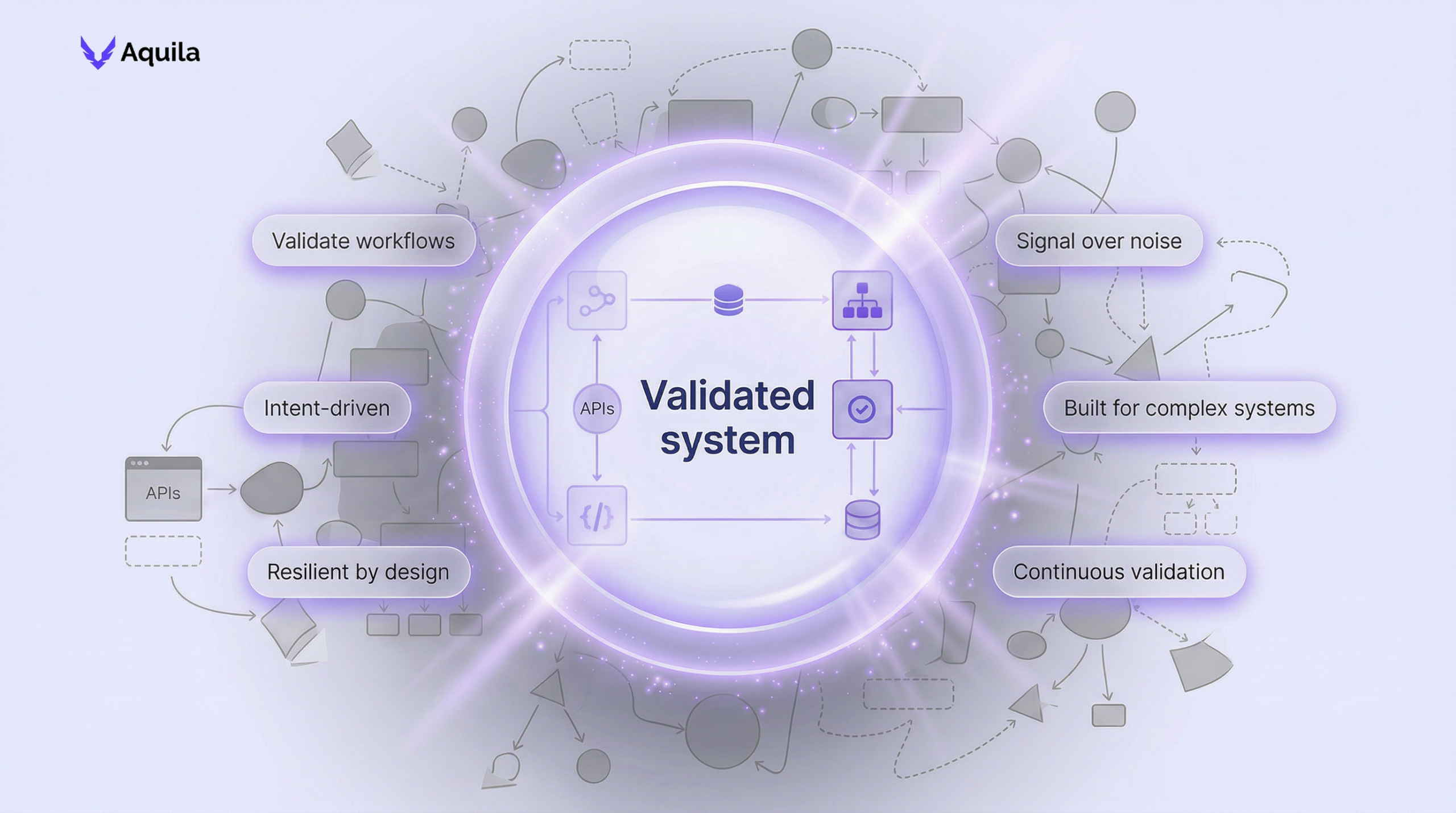
Validating systems, not just workflows
Most E2E tools answer one question: did the test pass or fail? But enterprise systems require a different set of questions:
- How stable is the system right now?
- Which workflows are carrying risk?
- If something fails, what else is impacted?
- Is the system actually ready for release?
This is where Aquila takes a fundamentally different approach. Instead of treating workflows as isolated tests, Aquila maps them as part of a connected system — every dependency tracked, every failure evaluated by its blast radius, every signal feeding into a real-time view of system stability.
Because in real systems: Failures don’t stay contained. They propagate. A seemingly low-risk flow can carry hidden risk if it depends on a high-risk upstream service. A single failure can impact multiple downstream workflows.
Aquila shifts the focus from:
- Test execution → system awareness
- Pass/fail → risk and impact
- Individual flows → dependency-aware validation
That’s the foundation of enterprise validation.
Final Thoughts
End-to-end testing isn’t about running more tests. It’s about understanding how your system behaves under real conditions.
But in modern systems, that knowledge can’t come from test results alone. A passing flow doesn’t guarantee stability. A green pipeline doesn’t mean you’re ready to release.
Confidence is no longer pass/fail. It’s a measurable state built on dependency awareness, risk visibility, and clear signals on system stability.
The teams that release calmly aren’t running the most tests. They’re the ones who can see how their system behaves as a whole.
That’s the shift:
- From executing tests to continuously validating systems
- From isolated flows to dependency-aware validation
- From pass/fail signals to release confidence
This is enterprise validation. And it’s the model Aquila is built around.
Build a release engine that understands your system, adapts as it evolves, and gives you real confidence in every release..→ See Aquila in Action
Frequently Asked Questions (FAQ)
What is end to end testing in simple terms?
End to end testing checks whether an application works as a complete system by simulating real user actions from start to finish. Instead of testing individual parts, it validates that entire workflows, like signup or checkout, actually work in real conditions.
Is end to end testing necessary for every application?
Not always. E2E testing is most useful for critical workflows that directly impact users or business outcomes. For smaller apps or low-risk features, unit and integration tests may be enough, but key user journeys should still be validated end to end.
How is end to end testing different from integration testing?
Integration testing verifies that different components or services work together correctly. End to end testing goes a step further by validating the entire user journey across the system, including UI, backend, databases, and external services.
What are the best tools for end to end testing?
Popular tools include Selenium, Cypress, and Playwright, which give developers control over test execution. Newer platforms like Aquila take a different approach by reducing maintenance overhead and focusing on continuous validation of workflows rather than just test automation.
References
Gartner. Research indicates that 80% of unplanned outages are caused by change, configuration, and integration issues.
https://www.gartner.com/en/documents/3985000