It was 2:47 AM when the alerts hit.
A fintech company had just pushed a major release. Over 1,200 automated tests passed flawlessly overnight. Test coverage sat at a confident 98%.
Then their payment confirmation workflow quietly failed. The checkout page worked and the API returned success. Customers saw confirmation messages.
But the orders never reached the systems that actually processed them.
A small change in a downstream service had broken the workflow somewhere between success and reality.
This wasn’t a testing problem. It was a dependency problem.
A workflow isn’t critical because it runs frequently. It’s critical because of how much of the business depends on it. The larger the dependency network, the larger the blast radius when it breaks.
That’s the premise behind Risk-Based Testing.
It stops asking, “Did we test everything?”
And starts asking the question that actually matters:
Did we validate the workflows the business can’t afford to get wrong?
What is Risk-Based Testing
Risk-Based Testing starts with a different definition of criticality.
Most teams already prioritize their testing efforts. The challenge is deciding what deserves the highest priority.
The question is: what are they prioritizing for?
Risk-Based Testing looks somewhere else. It prioritizes workflows based on dependency networks and blast radius. The more systems, services, and business processes depend on a workflow, the larger its blast radius becomes.
The more systems and teams depend on a workflow, the higher its validation priority becomes.
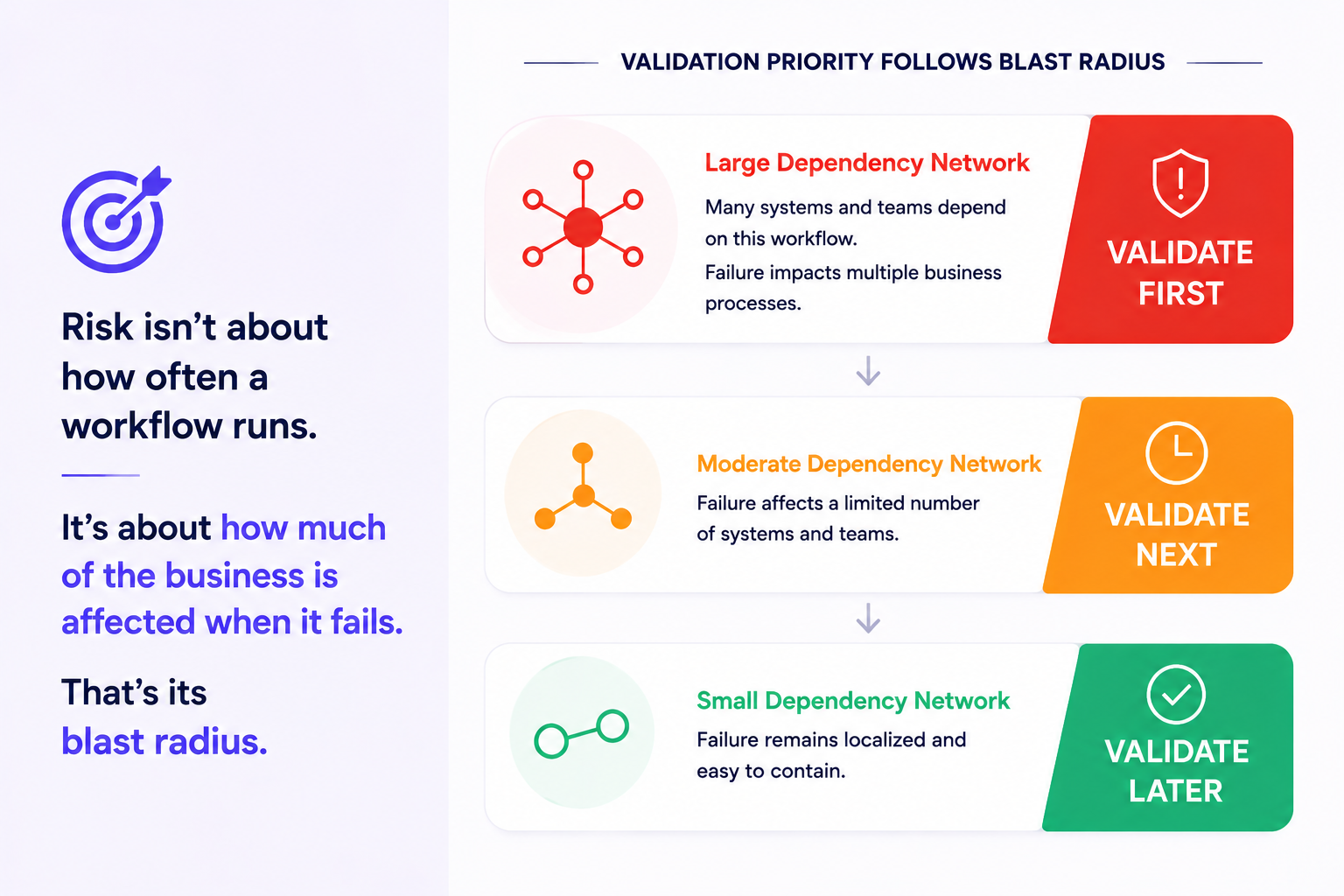
Larger dependency networks require earlier validation.
How Is It Different From Traditional Prioritization?
Traditional prioritization asks: “How important is this feature?”
Risk-Based Testing asks: “How much breaks if this workflow fails?”
| Traditional Prioritization | Risk-Based Testing |
| Prioritizes high-visibility features | Prioritizes high blast-radius workflows |
| Uses usage frequency as a signal | Uses dependency networks as a signal |
| Measures test execution | Measures dependency exposure |
| Optimizes for coverage | Optimizes for release confidence |
Related Reading: Why traditional software quality strategies fail in modern enterprise systems
Where Does Risk Actually Live?
Most teams don’t struggle because they aren’t testing enough.
They struggle because risk isn’t distributed evenly across their systems.
Some workflows sit at the center of large dependency networks spanning APIs, databases, third-party services, internal applications, and downstream teams.
Think:
- Lead-to-Revenue
- Quote-to-Contract
- Order-to-Cash
- Customer Onboarding
When these workflows fail, the impact rarely stays contained to a single feature or application.
The larger the dependency network, the larger the blast radius.
That’s why Risk-Based Testing doesn’t prioritize workflows based on usage or visibility alone. It prioritizes them based on dependency concentration and blast radius.
That’s where validation effort should go first.
Related Reading: What to Test: The Importance of Prioritizing Test Cases
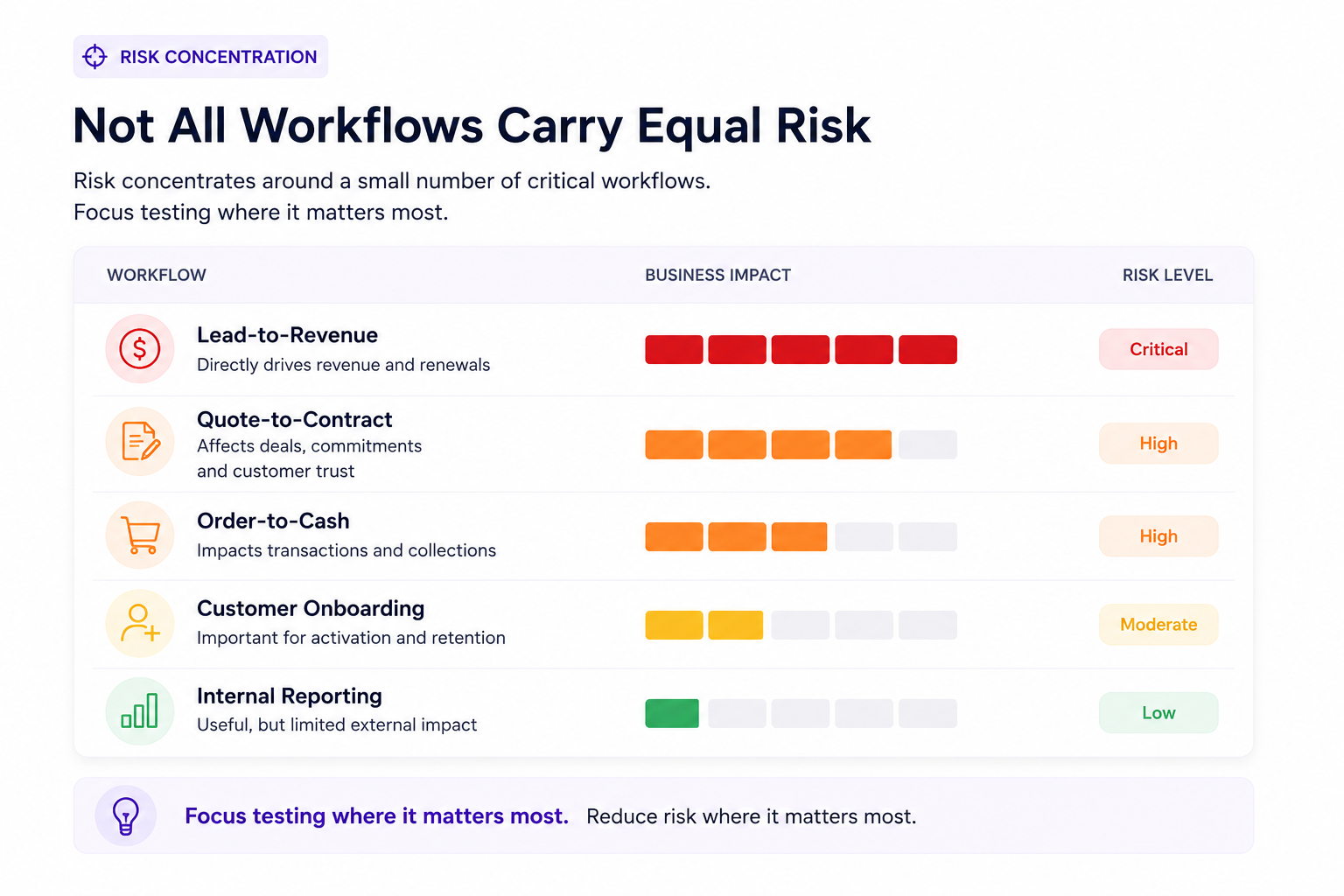
Risk concentrates around a small number of critical workflows.
What Makes a Workflow High Risk?
Ask these two simple questions:
- How many systems depend on this workflow?
- How much of the business breaks if it fails?
The answers usually tell you everything you need to know about validation priority.
Conclusion
The goal of testing was never to test everything. It was to reduce risk.
And risk rarely lives in individual features or applications. It concentrates around the workflows the business cannot afford to get wrong.
Risk-Based Testing ensures validation effort follows where risk is concentrated most.
As systems become increasingly interconnected, answering that question requires more than test coverage.
It requires visibility. That’s where Aquila comes in.
By validating release-critical workflows across interconnected systems, Aquila gives engineering teams something coverage metrics never could:
If you’re looking to move beyond test coverage and understand the real risk behind every release, see how Aquila helps teams release with confidence.