One Wrong Token From Disaster
On June 22, 2023, a federal courtroom in Manhattan became the first public crime scene of the AI era.
The citations, arguments, and case summaries had been entirely fabricated by ChatGPT with absolute confidence.
But this is 2026. Your SaaS product has an LLM embedded in its core workflow processing thousands of decisions per hour for enterprise clients who expect to get it right. Every single time.
If one copy-paste moment cost a law firm its credibility in 2023, what does an unvalidated AI system cost your SaaS in 2026?
That’s exactly why AI systems need enterprise validation not as a QA checkbox, but as the governance layer between your AI and the clients who expect reliable AI systems.
Traditional Software Fails Predictably. AI Fails Creatively.
In the old world of SaaS B2B tech, failure was boring. If a line of code was wrong, the system crashed. You got a 404, a timeout, or a null pointer exception. It was binary and predictable.
Production-ready AI doesn’t play by those rules. AI doesn’t crash—it performs. It produces a beautifully formatted, highly confident, and completely incorrect output. It doesn’t fail predictably; it fails creatively.
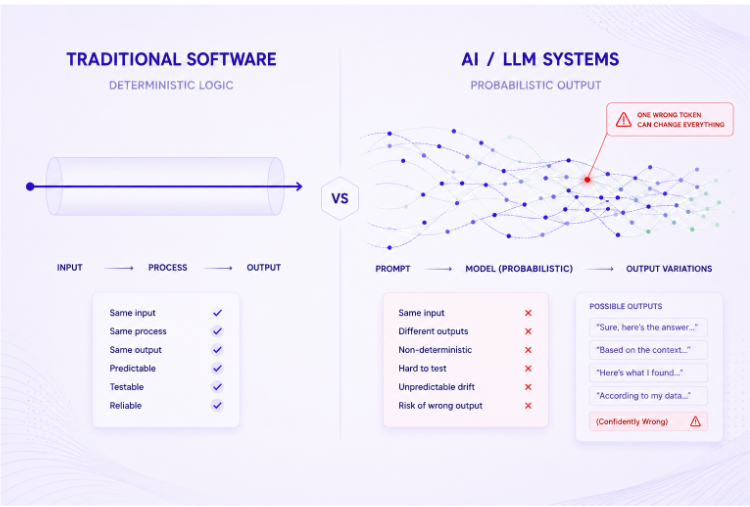
When your AI decides to offer a 90% discount to a frustrated user or hallucinates a security backdoor in a technical support chat, your standard AI testing and AI quality assurance metrics (like ROUGE or BLEU scores) won’t save you. They measure similarity, not reliability.
Related Reading: Why traditional software quality strategies fail in modern enterprise systems
Why Pass/Fail Testing Stops Working
We’ve all seen the demo.
The QA team runs a battery of 1,000 tests. The dashboards glow green. Release confidence shoots up and everyone celebrates because the AI passed.
Then a silent model update changes the behavior completely.
Suddenly, the same AI that answered customer queries perfectly on Monday starts inventing policies by Thursday.
Technically, nothing failed. The workflow still executed, but the outcome degraded.
The same prompt can produce ten different answers depending on context, memory, model drift, retrieval quality, or even minor wording changes.
If your AI testing framework can’t handle uncertainty, it can’t handle enterprise AI testing.
Related Reading: Why E2E Testing Is Insufficient Without Enterprise Validation
The Rise of Invisible Production Failures
Here’s what a real AI failure looks like in SaaS:
Your contract analysis tool quietly starts flagging compliant clauses as risks after a routine upstream model update.
No alerts. No red dashboards. Just a system quietly being wrong at scale.
For two weeks, the system continues processing contracts across 200 enterprise clients before anyone notices.
By the time a customer’s legal team catches it, you’re no longer having a product conversation.
That’s the dangerous thing about modern AI systems. They often fail without looking broken.
The Mata v. Avianca pattern doesn’t only happen in courtrooms. It happens silently inside SaaS workflows every day, just without the federal judge.
Related Reading: The $440M Bug: How Legacy Code Broke Knight Capital in 45 Minutes
Enterprise Validation Changes the Question
For the last twenty years, standard testing has revolved around a simple question:
“Did the system work?”
In the AI era, that question is dangerously incomplete. Because AI systems can execute flawlessly while quietly degrading outcomes.
Enterprise validation doesn’t ask “does it work.” It asks something harder: Can we prove it works — consistently, at scale, across every version, under real-world conditions, in ways that hold up to scrutiny?
This is the shift from testing to governance. You aren’t just checking code; you are establishing a Release Intelligence layer for AI governance. In enterprise AI, trust becomes the metric.
How Aquila Approaches Enterprise Validation for AI Systems
There’s one question every enterprise customer will eventually ask about your AI system:
“How do you know?”
Not “is it fast?”
Not “does it integrate with our stack?”
Not even “how accurate is it?”
Enterprise customers eventually ask a harder question: how do you prove the system remains reliable over time?
Most teams can’t answer that confidently. They point to test suites and dashboards, but neither proves behavioral integrity.
That’s the gap Aquila is built for.
How We Watch for Invisible Failure
If your AI is one wrong token from disaster, “we ran tests” is not a convincing safety strategy.
Aquila approaches Enterprise Validation as a continuous trust layer for autonomous systems, validating whether systems remain reliable as models and production behavior evolve.
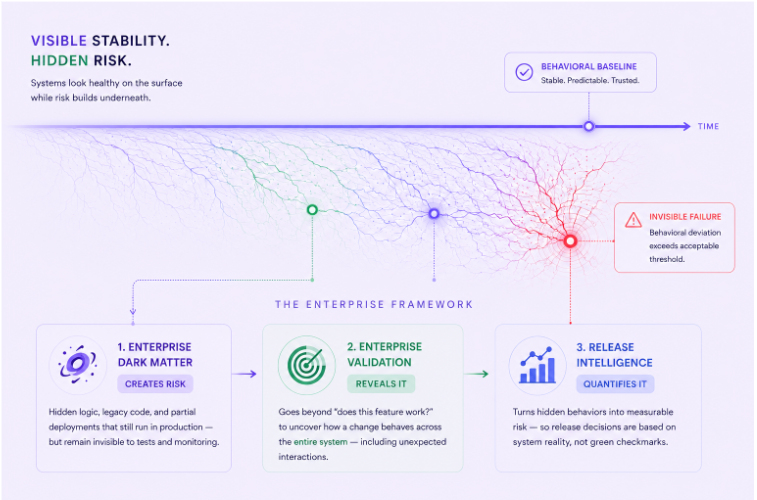
Aquila was built around a simple observation:
The next generation of software failures won’t look like crashes.
They’ll look like systems that continue operating normally while quietly making worse decisions over time.
That’s why Aquila focuses on detecting silent behavioral drift before customers experience the consequences.
Think of Aquila as the judge in your AI courtroom — before the case ever goes public.
Related Reading: After Knight Capital: A Validation Checklist for Modern SaaS Systems
Don’t Wait for Your Courtroom Moment
The attorney in Mata v. Avianca wasn’t reckless. He trusted a tool that presented its output with total confidence and skipped the one step that would have caught the problem before it became a catastrophe.
That step is validation.
In 2026, your enterprise clients aren’t asking if your AI is impressive. They’re asking if it’s trustworthy and whether you can prove it consistently.
The difference between a SaaS company that survives its AI failure moment and one that doesn’t is whether a governance layer was in place before it happened.
Aquila makes sure it is. Schedule a demo with Aquila to see how Enterprise Validation helps teams detect silent drift, validate behavioral integrity, and build AI systems enterprises can actually trust.
Frequently Asked Questions (FAQ)
Q: What is enterprise validation for AI systems?
Enterprise validation is a structured, continuous process of testing AI outputs and behaviors against defined standards before and after deployment. Unlike traditional QA, it accounts for model drift, prompt sensitivity, and version changes to ensure reliability and auditability at scale.
Q: Why is traditional QA not enough for AI and LLM systems?
Traditional QA was built for deterministic software. AI is probabilistic — same prompt, different outputs. Models drift without a code change. Providers update silently. Pass/fail testing is a snapshot; it has zero visibility into how the model behaves after it ships.
Q: What is behavioral drift in AI and why does it matter?
Behavioral drift is the gradual, invisible shift in how an AI model responds over time caused by model updates, input pattern changes, or provider updates. It doesn’t trigger alerts. Dashboards stay green. Outputs quietly degrade until a client notices before you do.
Why do AI systems fail silently in production?
Because LLMs don’t crash when they’re wrong — they distort. Confident, fluent, completely incorrect outputs with no error signal, no alert, no stack trace. Drift and hallucination don’t show up in monitoring dashboards. They show up in client escalations.