In July 2024, a routine software update from CrowdStrike triggered one of the largest IT outages in recent history. Airlines grounded flights, banks experienced disruptions, hospitals faced operational challenges, and millions of Windows systems crashed worldwide.
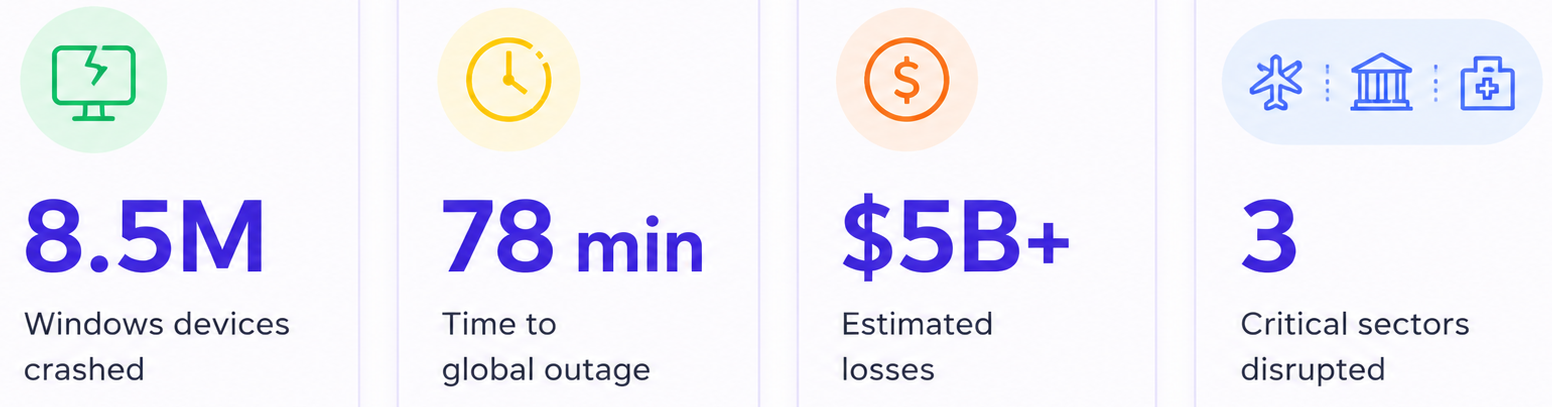
The release wasn’t blocked by a failing test suite.
It reached production. And that’s exactly the point.
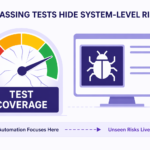
Enterprise software has become too interconnected for pass/fail testing alone. Applications now depend on APIs, cloud infrastructure, third-party services, and dozens of downstream systems that traditional automation often can’t fully account for.
The update wasn’t intended to break airlines, banks, and hospitals. But in modern enterprise environments, the impact of change often extends far beyond the component being modified.
Automation remains essential. But in highly interconnected systems, automation alone doesn’t answer the most important question:
Are we actually safe to release?
Release confidence is the ability to answer that question with evidence, not assumptions.
What Is Release Confidence?
Release confidence is the ability to determine whether a software release is truly safe to deploy across your enterprise ecosystem.
While automation tells you whether tests passed, release confidence tells you whether the release is safe. It considers the broader impact of change across systems, integrations, workflows, and customer experiences.
The difference is simple:
Automation vs Release Confidence
| Automation | Release Confidence |
| Focuses on test execution | Focuses on business risk |
| Measures pass/fail results | Measures release safety |
| Validates individual components | Validates interconnected systems |
| Answers “Did tests pass?” | Answers “Can we release?” |
Related Reading: Why AI Systems Need Enterprise Validation in 2026
Why Automation Alone Is No Longer Enough
Automation transformed software delivery. No argument there. But somewhere along the way, teams started treating more automation as the answer to every quality problem.
The reality is different.
Modern applications don’t operate in isolation. They’re connected through APIs, microservices, cloud infrastructure, databases, AI services, third-party platforms, and countless internal systems.
In such interconnected environments, a small change can create unexpected downstream effects.
Even the most comprehensive test suite can only validate the scenarios it was designed to check. It can’t predict every interaction across a complex enterprise ecosystem.
That’s why organizations running thousands of automated tests still find themselves dealing with costly production incidents.
Related Reading: Why traditional software quality strategies fail
What Creates Release Risk in Modern Enterprises?
The biggest release risks rarely come from the code you’ve tested.
They emerge from the systems, dependencies, and workflows surrounding it.
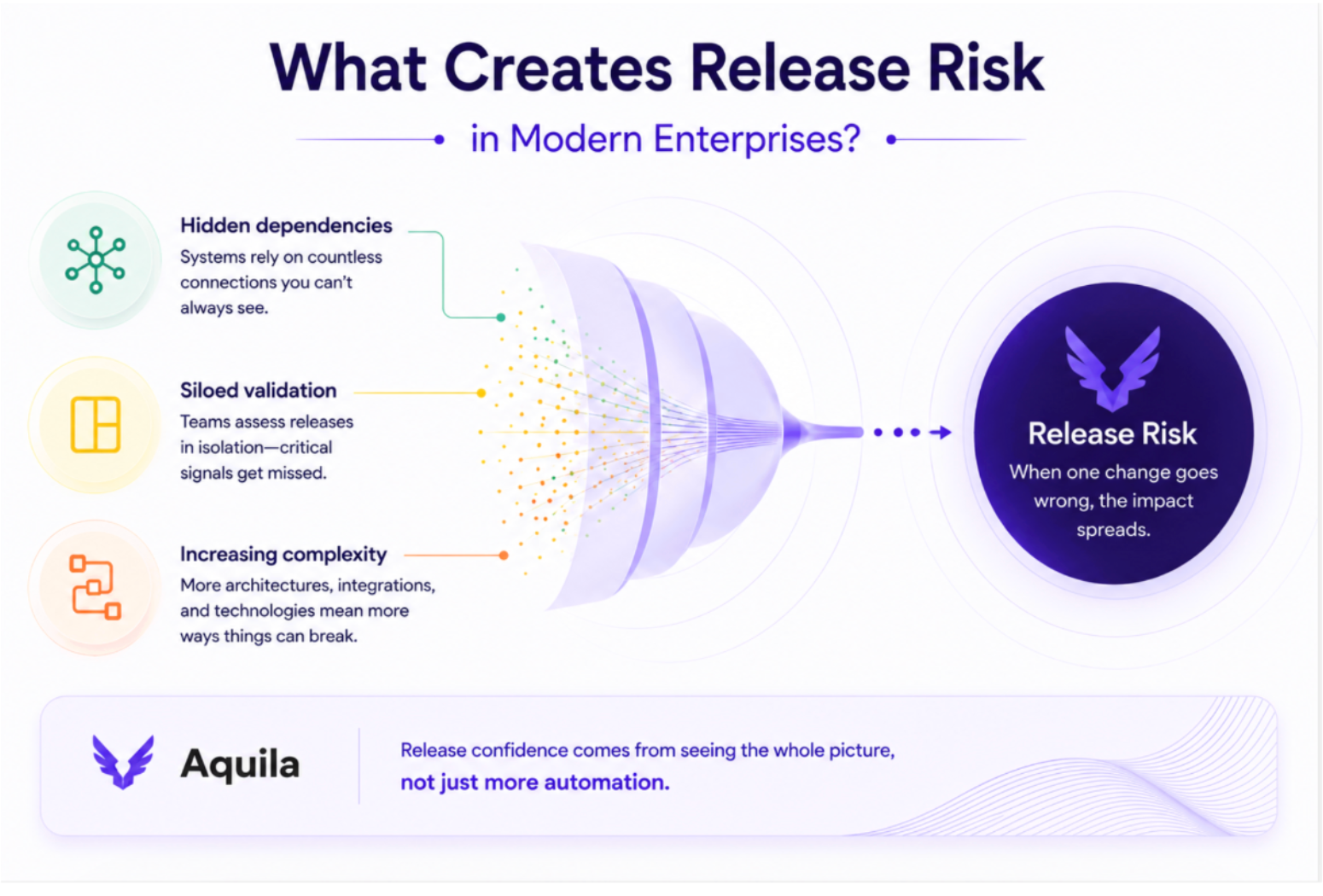
Release risk extends far beyond the code you changed.
The $1.7B Lesson from a Global Retailer
A leading global e-commerce platform reportedly learned this lesson the hard way in 2021.
A release passed automated validation and moved into production ahead of a major shopping event. Within hours, checkout failures began impacting customer transactions.
Tests passed. Customers couldn’t buy.
The incident highlighted a growing challenge for enterprises: automation can verify expected behavior, but it can’t always reveal how change will behave across complex, interconnected systems.
That’s exactly why release confidence matters.
Related Reading: How Legacy Code Broke Knight Capital in 45 Minutes
What Does True Enterprise Release Confidence Look Like?
Software quality has evolved in stages.
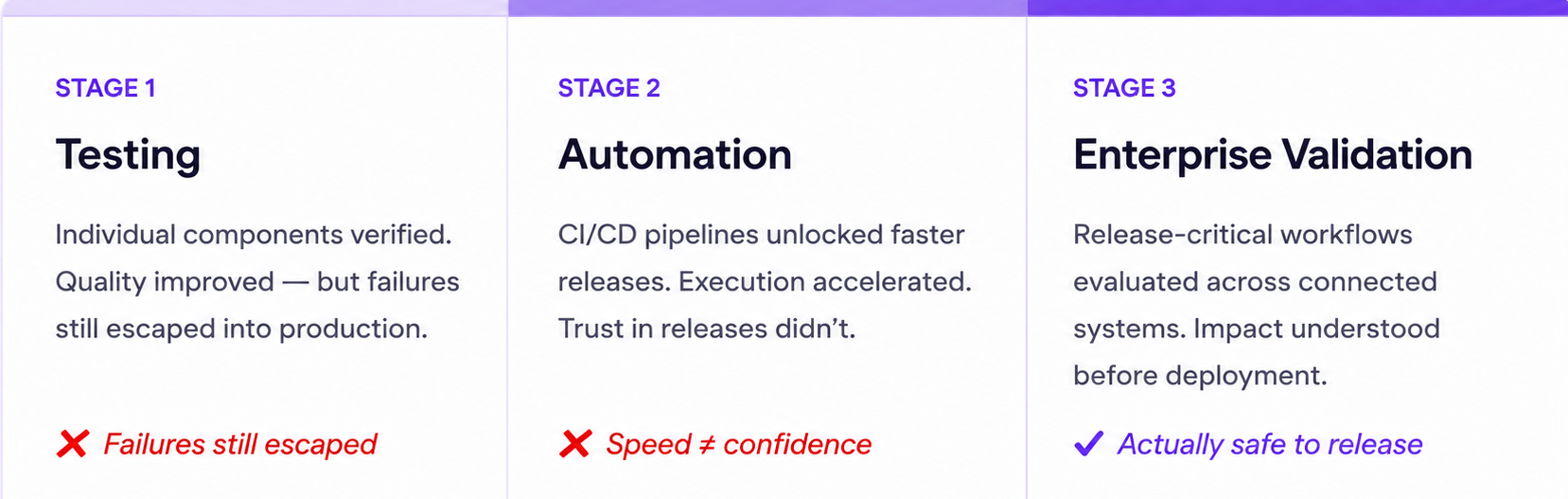
Evolution from testing and automation to enterprise validation
First came Testing. Teams needed to know whether individual components worked.
Then came Automation. Teams needed to validate faster and scale releases.
Both solved important problems. Neither solved release confidence.
That’s why a new discipline is emerging: Enterprise Validation.
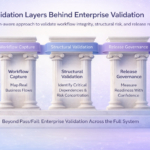
Enterprise Validation starts where testing stops. Instead of validating individual components, it validates how changes impact connected systems, business workflows, and release-critical processes.
How Aquila Enables Release Confidence at Enterprise Scale
Understanding release risk is one thing. Acting on it is another.
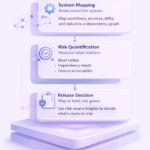
That’s why Aquila approaches Enterprise Validation in three steps:
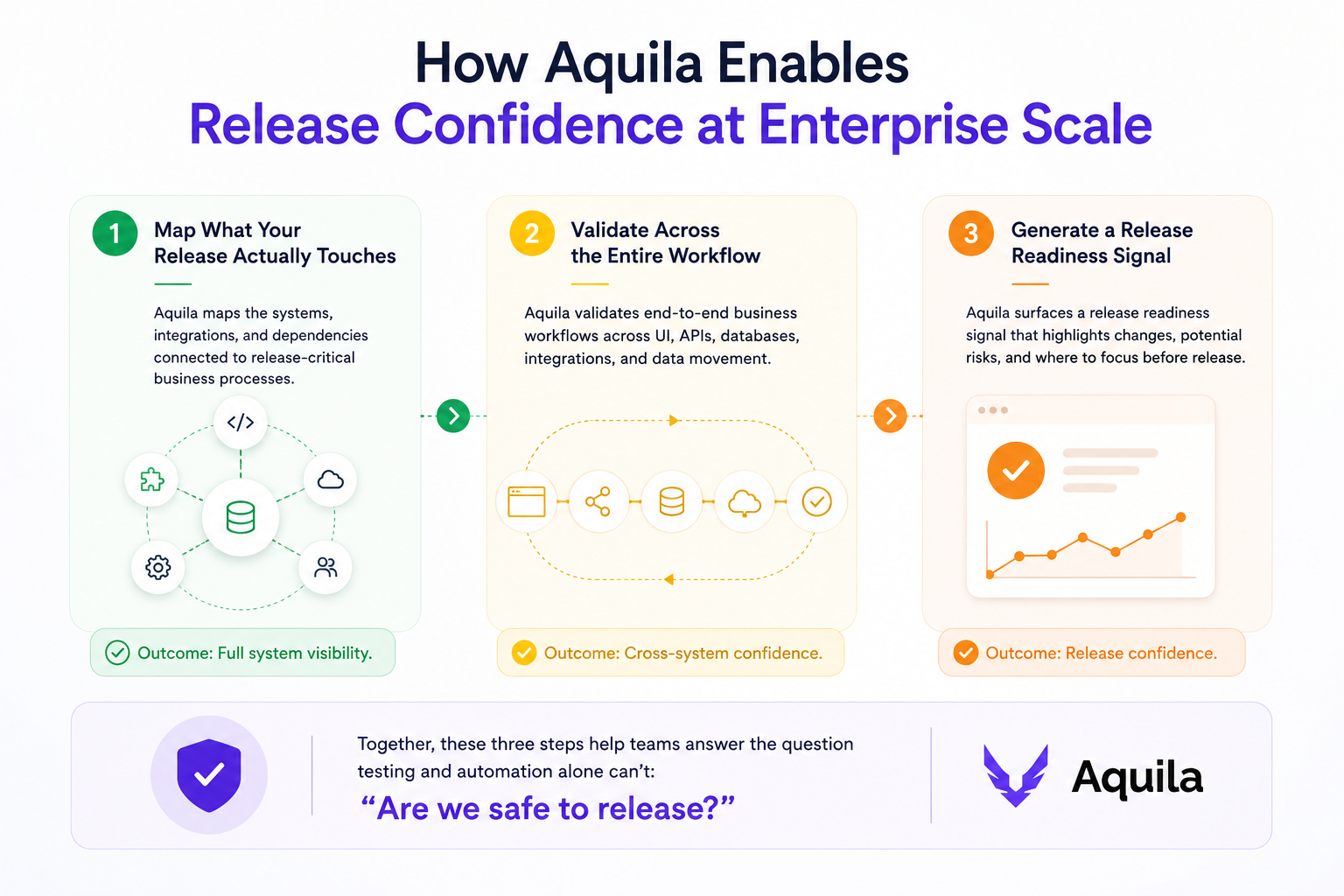
How Aquila turns release uncertainty into release confidence.
1. Map What Your Release Actually Touches
Most releases affect far more than the application itself.
Aquila maps the APIs, databases, workflows, integrations, third-party services, and internal systems connected to release-critical business processes.
Outcome: Full system visibility.
2. Validate Across the Entire Workflow
Traditional testing validates individual components.
Aquila validates end-to-end business workflows across connected systems, including UI interactions, APIs, databases, integrations, and data movement.
Outcome: Cross-system confidence.
3. Generate a Release Readiness Signal
The final step isn’t another test report.
Aquila surfaces a release readiness signal that shows what changed, which workflows may be at risk, and where teams should focus attention before deployment.
Outcome: Release confidence.
Related Reading: A Validation Checklist for Modern SaaS Systems
A Business Imperative, Not Just a QA Goal
This isn’t just a QA conversation anymore. It’s a business one.
Enterprise software failures don’t just create bugs. They can trigger SLA breaches, customer churn, compliance risks, and reputational damage.
The answer isn’t more automation. It’s better validation.
The most effective teams are moving beyond “tests passed” and asking a more important question: “Are we actually safe to release?”
That’s the role of Enterprise Validation.
Because in modern enterprises, a green pipeline isn’t the goal.
Confident releases are.
Want to see how enterprises achieve release confidence? Explore Aquila’s Enterprise Validation platform. Schedule a demo.