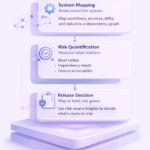
Engineering teams have spent years measuring test execution. The next decade will be about measuring release readiness.
For years, engineering teams have relied on metrics like test coverage, pass rates, and green CI/CD pipelines to determine release quality. But modern software is no longer a collection of isolated applications. It’s a network of APIs, databases, cloud services, third-party integrations, and AI-powered systems.
That’s why production incidents still occur even when every dashboard looks healthy.
The problem isn’t a lack of testing. It’s a lack of visibility into whether the entire system is truly ready for release.
This is why release readiness is quickly emerging as a new engineering KPI.
Related Reading: Why Enterprises Need Release Confidence, Not Just More Automation
What is Release readiness?
Release readiness is the measure of whether a software release can be deployed safely and confidently into production.

Unlike traditional quality metrics that focus on individual test results, release readiness evaluates the health of critical business workflows, system dependencies, integrations, and potential release risks. It answers a simple but important question:
“Are we actually safe to release?”
What Is a Release Readiness Index?
A Release Readiness Index (RRI) is a consolidated measure of release health across interconnected systems.
Instead of focusing solely on test pass rates, the index evaluates factors such as:
- Critical path stability
- Workflow validation status
- Dependency risk
- Affected systems and nodes
- Defect concentration

High pass rates don’t always mean a release is ready for production.
Why Traditional Engineering KPIs Are Losing Their Predictive Power
Traditional engineering metrics provide valuable insights into testing activity, but they don’t always predict production success. As enterprise systems become more interconnected, teams need metrics that measure release risk, not just test execution.
| Traditional KPI | What It Measures | What It Misses |
| Test Coverage | Percentage of code or functionality tested | Business-critical workflows and dependency risks |
| Green CI/CD Pipelines | Successful test execution and builds | Whether connected systems will work correctly in production |
| Automation Coverage | Number of scenarios automated | Risk concentration across critical workflows |
| Pass Rate | Tests that passed vs. failed | Impact of failures on business operations |
| Tests Executed | Volume of testing activity | Actual readiness of the release |
Related Reading: Why traditional software quality strategies fail in modern enterprise systems
When Automation Metrics Flunked the Readiness Test
The Cost of Missing Holistic Validation
Consider the Knight Capital disaster. In 2012, an incomplete deployment of legacy code triggered millions of unintended stock trades, costing the firm $440 million in just 45 minutes. The deployment process succeeded. The release did not.
The failure wasn’t a lack of automation. It was a lack of holistic validation across the production environment.
Related Reading: After Knight Capital: A Validation Checklist for Modern SaaS Systems
Why Release Readiness Is Becoming a Leadership KPI
CTOs and VPs of Engineering aren’t asked, “Did the tests pass?” They’re asked:
- Are we exposed?
- Can we ship this release without risking an incident?
- What’s our risk posture going into production?
Traditional metrics like test coverage and pipeline status don’t answer those questions. Release readiness does.
That’s why leadership teams are beginning to pay attention. It translates engineering activity into business risk, provides a forward-looking view of release health, and offers a clear signal that leaders can act on.
Simply put, deployment metrics tell leaders how fast teams move. Release readiness tells them whether that speed is safe.
Achieving True Release Readiness with Aquila
Knowing you need a readiness score is one thing. Generating one that’s actually trustworthy is another and that’s where most teams get stuck. You can’t calculate readiness from test logs alone; you need visibility into how a release behaves across the entire system it touches.
That’s exactly what Aquila is built for.
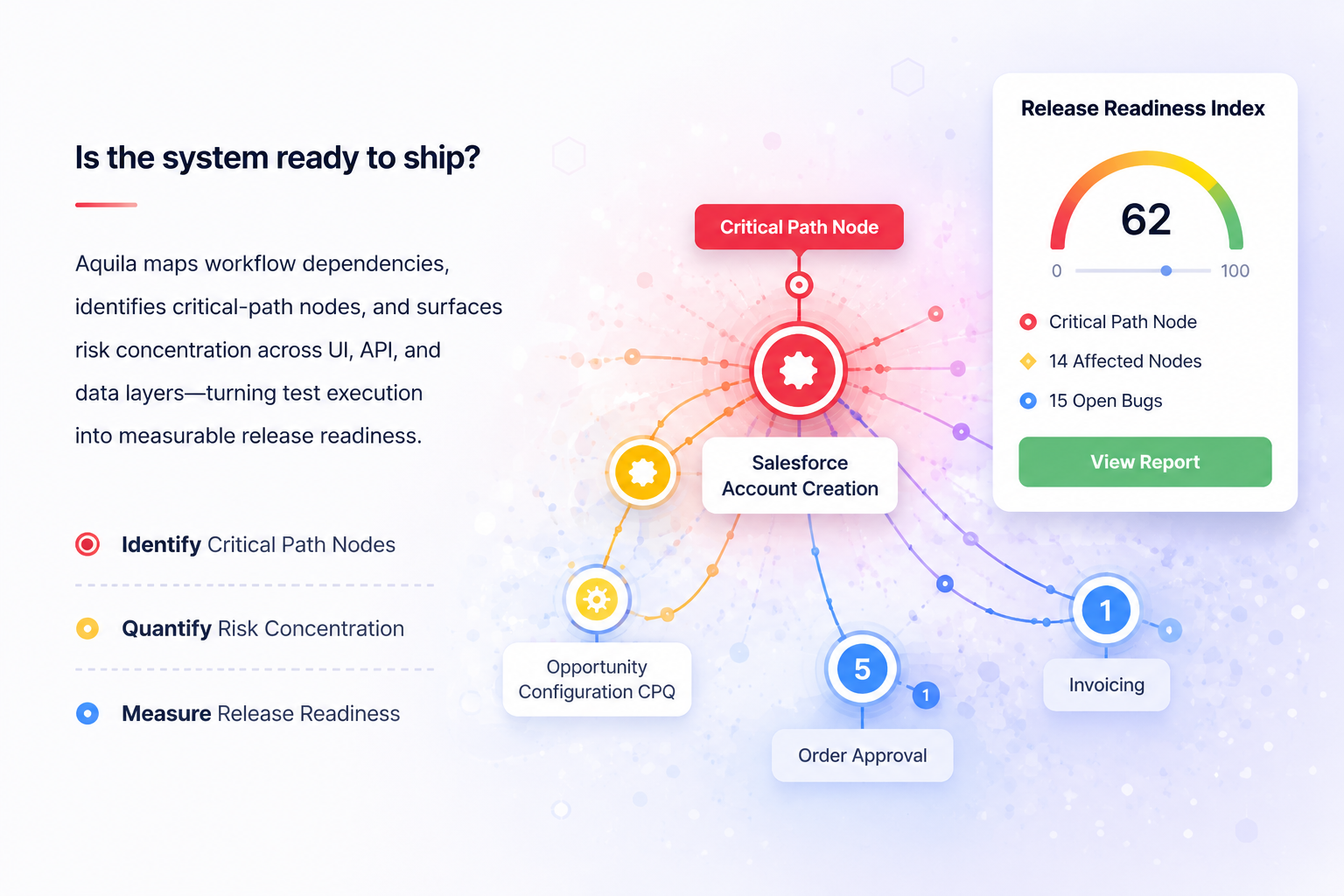
Release Readiness Index Dashboard
Aquila approaches release readiness as a continuous, system-wide signal not a one-time test report:
- Maps what the release actually touches — APIs, databases, third-party integrations, internal workflows — so nothing critical gets validated in isolation.
- Validates end-to-end business workflows, not just individual components, across the full stack: UI, APIs, data movement, and downstream systems.
- Generates a live Release Readiness Index that tells teams exactly where risk is concentrated, before deployment — not after.
Instead of a wall of pass/fail logs, teams get one clear signal: what’s ready, what’s flagged, and what needs a second look. That’s the difference between hoping a release is safe and actually knowing it is.
Conclusion: Key Takeaways for AI & Engineering Leaders
Velocity without validation is simply an accelerated path to failure. In a world of interconnected enterprise systems, shipping fast means little if critical business workflows break in production.
As release risk becomes a business concern, engineering leaders should focus on four principles:
- Automation Is Not Readiness: Passing tests measures execution. Release readiness measures deployment confidence.
- Validate the Entire System: Critical workflows span UI, APIs, databases, and third-party services. Validate them end to end.
- Prioritize Risk Over Coverage: Focus on release-critical paths, not vanity coverage metrics.
- Turn Data Into Release Intelligence: Use Enterprise Validation platforms like Aquila to transform test results into clear release readiness signals.
The future belongs to teams that don’t just ship faster, but ship with confidence. Want to see what your own release readiness score looks like? Book a demo with Aquila.
Frequently Asked Questions (FAQs)
What is release readiness in software engineering?
Release readiness is the measure of whether a software release can be deployed safely into production. It evaluates critical workflows, dependencies, integrations, and business risk to determine if a release is truly ready to ship.
Why is release readiness becoming an engineering KPI?
Traditional metrics such as test coverage and pass rates measure testing activity, not deployment risk. Release readiness provides engineering leaders with a clearer view of release health and potential business impact before deployment.
What is a Release Readiness Index (RRI)?
A Release Readiness Index (RRI) is a consolidated measure of release health based on factors such as workflow validation, dependency risk, integration stability, and change impact. It helps teams make informed release decisions with greater confidence.
How is release readiness different from test coverage?
Test coverage measures how much of an application has been tested. Release readiness measures whether business-critical workflows and interconnected systems have been sufficiently validated for production deployment.
How does Enterprise Validation improve release readiness?
Enterprise Validation helps teams validate release-critical workflows across UI, APIs, databases, and connected systems. This provides visibility into risk concentration and readiness before changes reach production.